Alternatives to Amazon Product Advertising API
Compare three ways to access Amazon product data: a REST/GraphQL managed API, Amazon's official APIs, or third‑party scraping—pros, pricing, and tradeoffs.

If you're looking for ways to access Amazon product data without relying on the Product Advertising API, here are three main options:
- Canopy API: A flexible tool offering both REST and GraphQL endpoints to access Amazon data like prices, reviews, and availability. It’s great for developers with scalable pricing starting from a free plan (100 monthly requests) to $400/month for high-volume needs (100,000 requests).
- Official Amazon APIs (SP-API and MWS): These are designed for sellers and affiliates, providing reliable, real-time data directly from Amazon. However, they come with strict eligibility requirements, throttling limits, and a steeper learning curve.
- Third-Party Scraping APIs: These bypass official channels to extract public data directly from Amazon’s website. They offer broad access to product details but may face challenges like maintenance due to website updates and variable pricing depending on usage.
Each option has its strengths and weaknesses, depending on your goals, whether it's affiliate marketing, market research, or e-commerce operations.
Quick Comparison
| Option | Data Access | Pricing | Requirements | Best For |
|---|---|---|---|---|
| Canopy API | Amazon product data via REST/GraphQL | Free (100 requests), $400/month for 100,000 requests | None | Developers, scalable solutions |
| Official Amazon APIs | Direct from Amazon, real-time | Free (with throttling) | Must be a seller/affiliate | Sellers, affiliates |
| Third-Party APIs | Public Amazon data via scraping | $5–$350/month | None | Market research, flexible use |
Choose the one that fits your needs based on ease of use, data requirements, and budget.
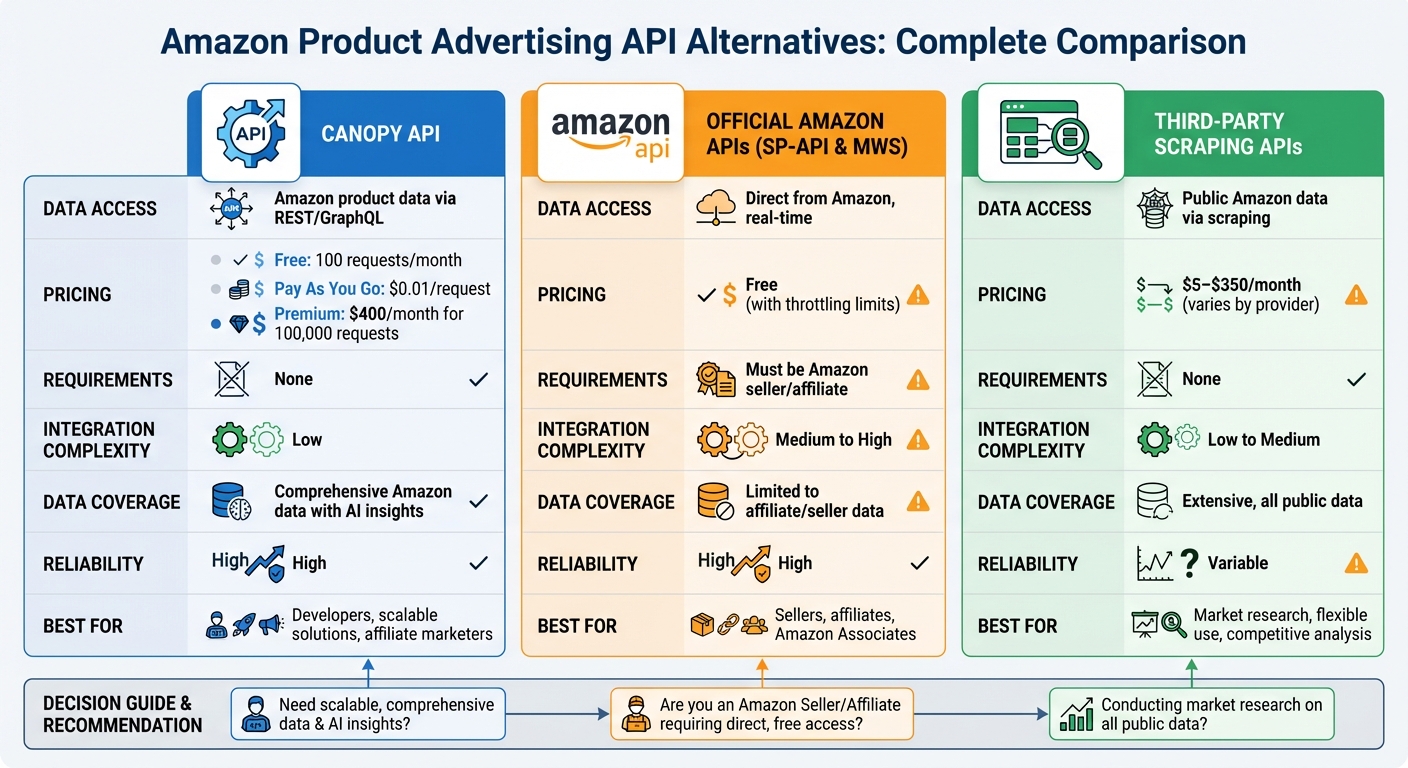
Amazon Product Advertising API Alternatives Comparison Chart
The Hidden Nightmare of Amazon’s API – and What We Use Instead | In the Know with Nhan
1. Canopy API
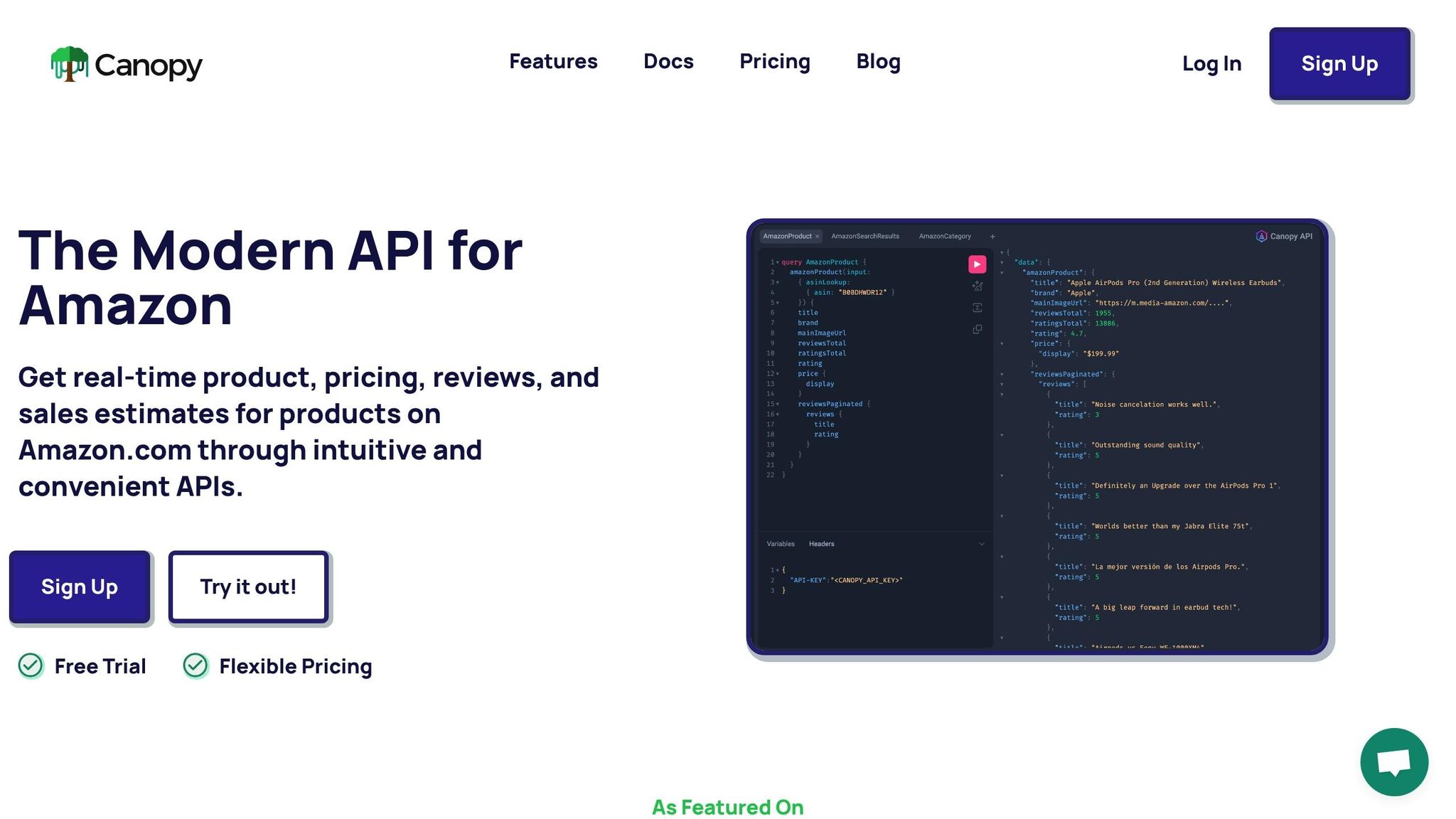
Canopy API is a strong alternative to the Product Advertising API, offering both REST and GraphQL endpoints to access Amazon product data. It’s a great fit for applications like price comparison, market research, and inventory management. Let’s dive into its standout features.
Data Coverage and Depth
Canopy API delivers real-time data from Amazon.com, including product details, pricing, customer reviews, and sales estimates. It also supports keyword-based searches, making it easier to discover products and analyze market trends. The structured data format ensures seamless integration, whether you’re monitoring a handful of items or managing thousands across diverse categories.
Data Freshness and Reliability
When it comes to staying updated, Canopy API pulls live data directly from Amazon to provide current pricing and availability. The GraphQL endpoint (https://graphql.canopyapi.co/) allows you to select specific fields, making queries more efficient and tailored to your needs.
Pricing and Scalability
Canopy API offers flexible pricing options. Start small with the free Hobby plan, which includes 100 requests per month - perfect for testing or smaller-scale projects. Need more? The Pay As You Go plan charges $0.01 per additional request, with discounts kicking in at 10,000 and 100,000 requests. For high-volume users, the Premium plan costs $400 per month, covering 100,000 requests, with extra requests priced at $0.004 each.
Integration and Developer Experience
Both the REST (https://rest.canopyapi.co/) and GraphQL endpoints are supported by detailed documentation and open-source examples. REST is perfect for straightforward queries, while GraphQL is ideal for retrieving precise data. Plus, AI-powered insights help you spot product trends, making it easier to stay ahead in a competitive market.
2. Official Amazon APIs and Reports
Amazon provides a range of APIs, including the Selling Partner API (SP-API) and Amazon Marketplace Web Service (MWS), designed to help sellers and vendors manage their operations within Amazon's ecosystem. Let’s break down the key aspects of these tools, including their data capabilities, reliability, pricing structure, and integration process.
Data Coverage and Depth
Amazon’s official APIs go far beyond basic product advertising tools. The SP-API, for instance, enables sellers to handle tasks like managing listings, tracking orders, and reconciling payments. According to Amazon, these APIs provide access to much of the data used on their platform, including details about items for sale and various functionalities available on Amazon.com, such as product searches and promotions. It's worth noting that these APIs are specifically tailored for Amazon Associates and sellers, making them less suitable for general market research or price comparison purposes.
Data Freshness and Reliability
One of the standout features of Amazon’s APIs is their connection to the same infrastructure that powers Amazon.com. This ensures that the data - whether it’s pricing or product availability - remains as up-to-date as possible. Amazon highlights this in their documentation:
Amazon has developed a world-class web service that millions of customers use every day. As a developer, you can build Product Advertising API applications that leverage this robust, scalable, and reliable technology.
This reliability means you’re working with live data that reflects Amazon’s real-time e-commerce operations.
Pricing and Scalability
Amazon’s APIs don’t charge per request, but they do impose throttling limits, which restrict the number of requests you can make per second. Managing these limits effectively is crucial to maintaining smooth operations. While the SP-API offers advanced capabilities for global merchants, it comes with a steeper learning curve, making it a better fit for businesses with more complex needs.
Integration and Developer Experience
To access these APIs, you’ll need to be an Amazon Associate or a registered seller. While the documentation is detailed and thorough, the complexity of these tools - and the requirement to already be part of Amazon’s ecosystem - makes them more suitable for businesses deeply integrated with Amazon. For developers looking for simpler or more flexible ways to retrieve product data, these APIs may not be the best fit.
sbb-itb-d082ab0
3. Third-Party Scraping APIs
Third-party scraping APIs take a different route to access Amazon data, bypassing official channels and extracting information directly from the website. This approach allows access to a wider range of data points compared to official APIs. These services can provide details like product prices, availability, descriptions, ratings, reviews, and other specific information that might not be available through Amazon's own APIs.
Data Coverage and Depth
These APIs shine when it comes to flexibility and the variety of data they can provide. Unlike official APIs, which are often tailored for affiliate marketing or seller operations, third-party scraping APIs support broader use cases such as market research, competitive analysis, inventory management, and price comparison tools. Because they pull data directly from Amazon's website, they can capture nearly all publicly visible information, including some details that official APIs may not offer.
Data Freshness and Reliability
To navigate the challenges of web scraping, these services use advanced techniques like large pools of IP addresses (spanning residential, datacenter, and mobile networks), automatic proxy rotation, and CAPTCHA-solving tools. These features ensure uninterrupted access to Amazon data. Many providers enhance usability by offering dedicated e-commerce endpoints that transform raw HTML into structured formats like JSON or CSV. This ensures consistency even when Amazon updates its website layout. Additionally, features like built-in schedulers and webhook delivery options allow for automated and real-time data collection.
Pricing and Scalability
Most third-party scraping APIs operate on a credit-based subscription model. Pricing typically ranges from $5 to $350 per month, depending on factors like the number of credits, concurrent jobs, and overall resource usage.
Integration and Developer Experience
These APIs are designed with developers in mind, offering straightforward REST endpoints and detailed documentation. Unlike official APIs, you don’t need to be an Amazon Associate or a registered seller to start using them. This ease of access makes them a convenient option for a wide range of users.
Pros and Cons
When it comes to accessing Amazon data, each option comes with its own set of advantages and challenges. Let’s break them down:
Canopy API shines with its modern GraphQL and REST interfaces, providing real-time Amazon data enriched with AI-driven insights. Its flexible pricing model and simplified integration make it an attractive option for developers who want to avoid the technical complexities of building from scratch.
Official Amazon APIs offer a direct and reliable source of data straight from Amazon itself. However, these come with strict eligibility requirements and can be tricky to integrate, especially for businesses or developers without prior API experience.
Third-party scraping APIs take a different approach by extracting public Amazon data directly from the website. They handle much of the technical heavy lifting, but they come with their own challenges. Frequent updates to Amazon’s HTML structure can create maintenance headaches, especially if the API provider doesn’t offer robust parsing capabilities. Pricing can also be unpredictable, with some providers charging extra for features like geotargeting or advanced rendering.
Here’s a quick comparison of these options:
| Solution | Data Coverage | Reliability | Pricing Range | Integration Complexity |
|---|---|---|---|---|
| Canopy API | Comprehensive Amazon data with AI insights | High, backed by reliable infrastructure | $0.01/request after 100 free | Low, supports REST and GraphQL |
| Official Amazon APIs | Limited to affiliate/seller data | High, sourced directly from Amazon | Free (with restrictions) | Medium to high, strict requirements |
| Third-Party Scraping APIs | Extensive, includes all public data | Variable, depends on anti-bot measures | Varies by provider | Low to medium, depends on provider |
Ultimately, the decision boils down to balancing control and convenience. Official Amazon APIs provide direct, reliable access but come with ecosystem limitations and eligibility hurdles. On the other hand, third-party scraping APIs offer more flexibility but may require ongoing maintenance and come with variable costs. For developers who want a middle ground - reliable, easy-to-integrate, and comprehensive data access - Canopy API offers a streamlined solution that minimizes technical overhead while delivering consistent, real-time results.
Conclusion
Each solution discussed above offers specific benefits tailored to different needs, making the choice largely dependent on your goals and priorities. When considering alternatives to the Amazon Product Advertising API, affiliate marketers, market researchers, and developers need to weigh their unique requirements against factors like ease of integration and pricing flexibility.
For affiliate marketers, the Amazon Product Advertising API is purpose-built, offering direct access to product data for affiliate use cases. However, for those new to development or looking to sidestep strict usage rules and throttling limits, the Canopy API provides a user-friendly alternative. It features a pay-as-you-go pricing model - charging just $0.01 per additional request after 100 free monthly requests - making it accessible and cost-effective.
For market researchers and retail professionals, third-party scraping APIs can deliver broad data coverage but often require ongoing maintenance as website structures evolve. On the other hand, Canopy API offers a more hands-off approach, providing real-time, AI-driven insights without the hassle of upkeep. This includes access to product details, pricing trends, customer reviews, and historical data - key tools for competitive analysis and inventory planning.
For developers, simplicity and scalability are crucial. Canopy API stands out with its easy-to-use REST and GraphQL integration, along with flexible pricing plans. Whether you’re using the free Hobby plan with 100 requests per month or scaling up to the Premium plan at $400/month for 100,000 requests, it’s designed to grow with your needs. Ultimately, the decision comes down to finding the right balance between performance demands and the freedom to innovate.
FAQs
How does Canopy API differ from Amazon's official APIs?
Canopy API offers a versatile way to access product data, pricing, and availability without relying on Amazon's official APIs. This independence gives businesses greater control and the ability to tailor solutions to meet specific requirements.
On the other hand, Amazon's APIs provide direct access to marketplace data but come with strict usage policies, API key requirements, and certain limitations. Canopy API prioritizes easy integration and intuitive features, making it a smart choice for businesses aiming to streamline their operations and improve their e-commerce strategies.
How does Canopy API keep product data accurate and up-to-date?
Canopy API provides accurate, up-to-date product data by tapping into Amazon's official data sources and connecting directly with their APIs. By utilizing real-time updates and advanced synchronization methods, it ensures you get the latest details on pricing, availability, and product specifications.
With continuous monitoring and automated processes, Canopy API maintains dependable and consistent data. This means businesses and developers can rely on it to reflect current market trends and make informed decisions for their e-commerce operations.
What are the common challenges of using third-party scraping APIs?
Using third-party scraping APIs isn't without its hurdles. A big concern is the accuracy and timeliness of data - scraped information might not always reflect the most current or correct details. On top of that, some APIs impose restrictions, leading to limited access to certain features or datasets.
There's also the issue of relying on the provider for updates and maintenance. If the service goes down or struggles to adapt to changes on the platforms it scrapes, your workflow could be seriously affected. And let's not forget about customer support delays - technical issues might take longer to resolve than you'd like, depending on how quickly the provider responds.