Changelog: Enhanced Amazon Product Offers Data
Canopy API adds seller ratings, delivery flags, and order limits to Amazon product offers across 350M products, accessible via REST or GraphQL.

The Canopy API now provides more detailed Amazon product offers data, going beyond basic price and ID information. Developers can access new fields like seller ratings, delivery options, and order limits, enabling smarter e-commerce tools and better user experiences. Key updates include:
- Order Constraints: Fields like
minimumOrderQuantityandmaximumOrderQuantityhelp manage inventory and bulk purchases. - Delivery Logistics: Flags such as
fulfilledByAmazonandshippedFromOutsideCountryclarify shipping methods and potential delays. - Seller Information: Details like seller name, ratings, and images build customer trust and streamline decision-making.
This update covers 350 million products across 25,000+ categories and supports both REST and GraphQL queries, making it easier to integrate into various applications. These enhancements simplify seller evaluation, improve product data management, and enable advanced e-commerce features like price tracking and automated purchasing systems. Developers can retrieve this data at scale, with pricing starting at $400/month for 100,000 requests.
What's New: Additional Fields in the Offers Object
The offers object has been updated with several new fields that provide deeper insights into pricing, seller details, and logistics. These additions focus on three key areas: order constraints, delivery logistics, and seller information. The goal? To help developers create smarter e-commerce tools, price trackers, and automated purchasing systems.
Order Constraints
New fields such as minimumOrderQuantity, maximumOrderQuantity, conditionIsNew, and title offer clarity on purchase restrictions and product conditions. These are particularly helpful for B2B scenarios or carts that need to manage inventory efficiently.
Delivery Logistics
Delivery-related updates include two new flags:
fulfilledByAmazon: Indicates whether shipping is handled by Amazon.shippedFromOutsideCountry: Highlights international shipments, which might come with delays.
Enhanced Seller Information
The seller object now provides a more detailed look at sellers, including fields like:
nameandlink: Basic seller details and direct access to their storefront.- Rating metrics:
ratingsPercentagePositive,rating, andratingsTotal. imageUrl: A visual element that can serve as a trust signal.
Starting August 4, 2025, Amazon introduced star-only ratings, making fields like ratingsPercentagePositive even more critical for evaluating seller credibility. For instance, the ratingsTotal field helps differentiate between sellers with minimal feedback and those with a robust track record. This level of detail gives developers tools to better assess seller reliability and legitimacy.
Tygh Walters, Co-Founder and CEO of SellerSmile, notes, "Amazon is further bridging the gap between shoppers and sellers... earning buyer trust by facilitating the way sellers engage with product reviews."
Why It Matters
With these updates, developers can now build ranking systems that weigh factors like price, product condition, seller reputation, and fulfillment options. This single API response covers a staggering 350 million products across more than 25,000 categories, making it a powerful tool for creating advanced e-commerce solutions.
Before and After: Old vs. New Offers Data Structure
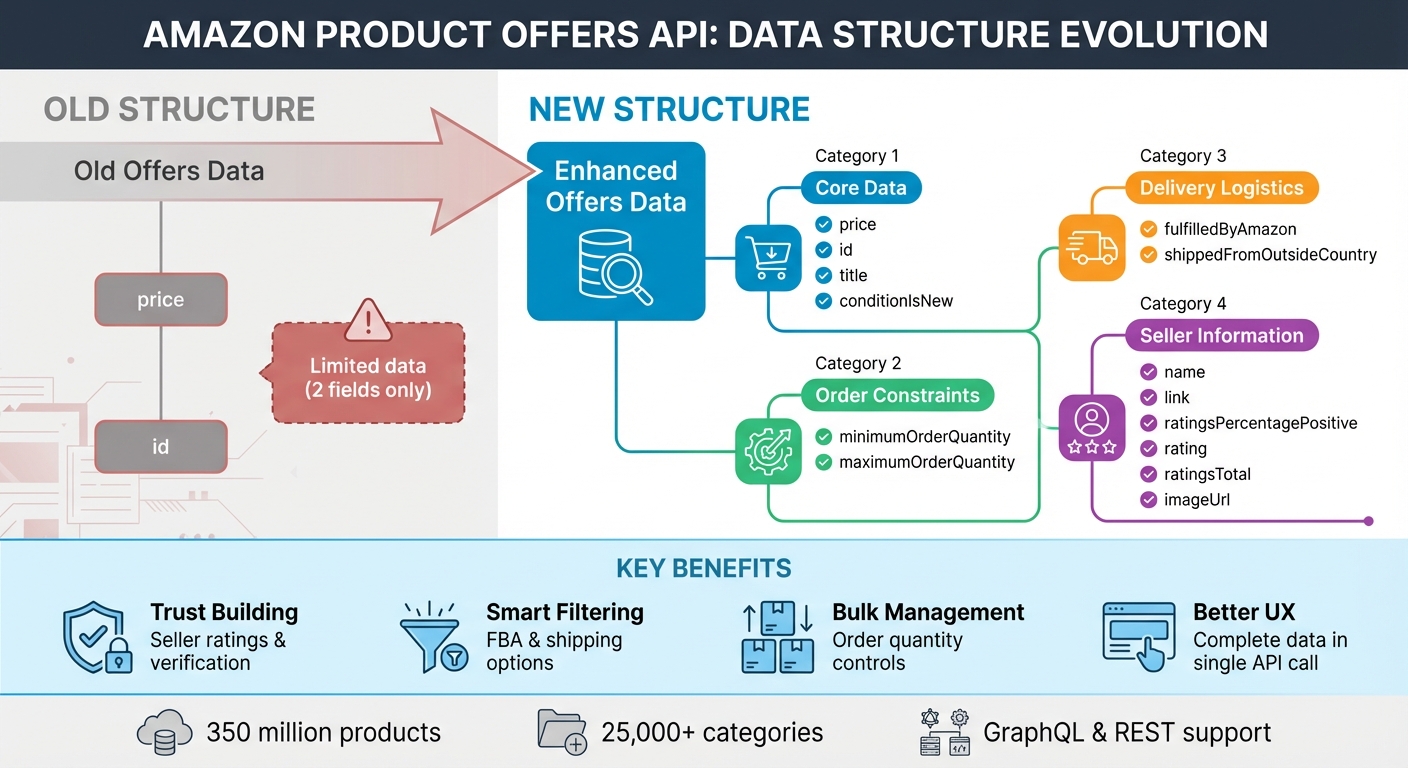
Amazon Product Offers API: Old vs New Data Structure Comparison
Let’s take a closer look at how the offers data structure has evolved. The original version was pretty basic, including just a price and an ID. It didn’t provide any details about the seller, shipping options, or order limits - leaving a lot to be desired in terms of functionality and context.
The updated structure, however, is a game-changer. It expands from just two fields to more than 14, covering everything from order constraints to delivery logistics and seller credibility. This richer data set provides a much more comprehensive view for users.
Table: Old vs. New Fields Comparison
| Category | Old Structure | New Structure | Benefits |
|---|---|---|---|
| Core Data | price, id |
price, id, title, conditionIsNew |
Adds product details and clarifies condition |
| Order Limits | Not available | minimumOrderQuantity, maximumOrderQuantity |
Supports bulk purchasing and inventory control for B2B scenarios |
| Delivery | Not available | fulfilledByAmazon, shippedFromOutsideCountry |
Improves shipping speed estimates and sets expectations for international orders |
| Seller Info | Not available | name, link, ratingsPercentagePositive, rating, ratingsTotal, imageUrl |
Enables trust-building through seller reputation and visual branding |
The new structure opens up exciting possibilities. For example, you can now create ranking systems that weigh ratingsTotal against ratingsPercentagePositive to highlight the most reliable sellers. The addition of the imageUrl field even allows for displaying seller logos, adding a visual layer of trust to your user interface.
The fulfilledByAmazon flag is another standout. It makes it easy to filter for FBA listings, which often promise fast two-day delivery for Prime members. Meanwhile, the shippedFromOutsideCountry field helps manage customer expectations by flagging potential delays for international shipments.
These updates don’t just enhance the user experience - they also improve how applications perform by enabling smarter, more informed decision-making. Let’s explore how these features can be applied in practice in the next section.
How to Use the New Offers Data in Your Applications
With the updated data structure in place, you can now integrate these fields into your applications effortlessly. Access the enhanced offers data using the Canopy API through either GraphQL or REST, depending on what suits your application’s architecture.
GraphQL is ideal if you want to request only the fields you need, keeping the payload size small and improving performance - especially helpful for mobile apps or real-time dashboards. On the other hand, REST endpoints provide a fixed data structure, making them a better choice for simpler integrations or legacy systems.
To get started, authenticate each request by including your API key as a Bearer token in the Authorization header. Use POST requests at https://graphql.canopyapi.co/ for GraphQL, or GET requests at https://rest.canopyapi.co/ for REST.
GraphQL Query Example
Here’s an example of how to fetch offers data using GraphQL:
const API_KEY = process.env.CANOPY_API_KEY;
const ASIN = 'B0B3JBVDYP';

const query = `
  query GetProductOffers($asin: String!) {
    amazonProduct(input: { asin: $asin }) {
      title
      offers {
        minimumOrderQuantity
        maximumOrderQuantity
        conditionIsNew
        title
        delivery {
          fulfilledByAmazon
          shippedFromOutsideCountry
        }
        seller {
          name
          link
          ratingsPercentagePositive
          rating
          ratingsTotal
          imageUrl
        }
      }
    }
  }
`;

async function fetchOffers() {
  const response = await fetch('https://graphql.canopyapi.co/', {
    method: 'POST',
    headers: {
      'Authorization': `Bearer ${API_KEY}`,
      'Content-Type': 'application/json'
    },
    body: JSON.stringify({
      query,
      variables: { asin: ASIN }
    })
  });

  const result = await response.json();
  const offers = result.data.amazonProduct.offers;

  offers.forEach(offer => {
    console.log(`Seller: ${offer.seller.name}`);
    console.log(`Rating: ${offer.seller.rating} (${offer.seller.ratingsPercentagePositive}%)`);
    console.log(`Min Order: ${offer.minimumOrderQuantity || 'N/A'}`);
    console.log(`FBA: ${offer.delivery.fulfilledByAmazon}`);
  });
}

fetchOffers();
This query retrieves all the new fields in a single request. You can use this data to filter or sort offers based on criteria like ratingsTotal to highlight reliable sellers or prioritize those offering fast shipping using fulfilledByAmazon.
REST API Example
If you don’t need to customize the fields and prefer a simpler approach, the REST API provides the full offers object. Here’s an example:
const API_KEY = process.env.CANOPY_API_KEY;
const ASIN = 'B0B3JBVDYP';

async function fetchEnhancedOffers() {
  const response = await fetch(`https://rest.canopyapi.co/product/${ASIN}`, {
    method: 'GET',
    headers: {
      'Authorization': `Bearer ${API_KEY}`,
      'Content-Type': 'application/json'
    }
  });

  if (response.ok) {
    const data = await response.json();

    data.offers.forEach(offer => {
      console.log(`Condition New: ${offer.conditionIsNew}`);
      console.log(`Seller Image: ${offer.seller.imageUrl}`);
      console.log(`Ships from Outside US: ${offer.delivery.shippedFromOutsideCountry}`);
      console.log(`Max Order Quantity: ${offer.maximumOrderQuantity || 'No limit'}`);
    });
  } else {
    console.error('Failed to fetch offers:', response.statusText);
  }
}

fetchEnhancedOffers();
The REST endpoint delivers the complete offers structure, making it suitable for applications that need to display comprehensive product details or maintain uniform data across multiple pages. Be sure to handle cases where maximumOrderQuantity might be null.
These examples demonstrate how to efficiently retrieve and use the enriched data, paving the way for enhanced functionality in your e-commerce applications.
sbb-itb-d082ab0
How US E-commerce Applications Benefit from the New Data
The expanded offers data brings a boost to US e-commerce application development. With access to over 350 million Amazon products spanning more than 25,000 categories, these new fields provide detailed insights that help shoppers make better purchasing decisions. This update also enhances seller evaluation processes and improves operational workflows.
Better Seller Evaluation and Product Recommendations
Trust plays a huge role in the US e-commerce market. Buyers want transparency about sellers before committing to a purchase. Sellers with high ratings and strong feedback are a clear signal of dependability.
The fulfilledByAmazon flag is a game-changer here, enabling filters like "Fast Shipping" that align with Prime delivery standards. Meanwhile, the shippedFromOutsideCountry field informs users about potential delays, customs issues, or higher shipping costs for international orders.
When combined with the conditionIsNew field, applications can prioritize showcasing new-condition items from top-rated sellers with domestic fulfillment. This ensures users are presented with offers that meet their quality and delivery expectations. To add a visual layer of trust, the seller.imageUrl field allows customers to quickly identify seller branding, making the shopping experience even more seamless.
Faster Product Data Management
Beyond improving seller and shipping insights, the update simplifies product data management. Previously, developers had to rely on multiple API calls or manual processes to gather comprehensive offer details. Now, a single request provides all the key information, from seller ratings to minimum and maximum order quantities.
Fields like minimumOrderQuantity and maximumOrderQuantity are especially useful for automated procurement, helping prevent checkout errors by enforcing seller-defined purchase limits. This streamlined approach not only reduces manual data aggregation but also makes bulk purchasing validations more efficient.
For applications handling large volumes of requests, the Canopy API's pricing structure is a big plus - offering 100,000 requests in the Premium plan for $400/month. This allows developers to retrieve rich offer data at scale without breaking the bank.
Summary: What the New Offers Data Means for Your Projects
Amazon's updated offers data takes product integration to the next level. Instead of just basic details like price and ID, developers now gain access to a wealth of information in a single API call. This includes seller ratings, delivery indicators, order limits, and product condition. By consolidating these details, the new system eliminates the need for multiple API calls or manual data collection, saving both time and resources. These enhancements open the door to a range of new features and possibilities.
With the added fields, you can now create trust signals by showing seller ratings, filter products based on fulfillment methods using the fulfilledByAmazon flag, and avoid checkout issues by enforcing order quantity limits. The shippedFromOutsideCountry field helps set realistic delivery expectations, while conditionIsNew ensures clarity about the product's condition.
For applications handling heavy traffic, the Canopy API's Premium plan offers 100,000 requests for $400/month - just $0.004 per additional request. This makes it an affordable option for retrieving detailed offer data at scale, whether you're building price trackers, comparison tools, or automated procurement systems.
As highlighted in Amazon's PA-API documentation, "OffersV2 will completely replace the existing Offers API. All new Item Offer features will be added here. In addition to the data fields themselves, V2 also has increased reliability and data quality compared to V1". This means better uptime, more accurate data, and continuous feature updates to keep your applications ahead of the curve.
Whether you're working on product recommendation engines, inventory management systems, or e-commerce platforms, these expanded fields offer the depth and flexibility to create smarter, more reliable tools. This update marks a major improvement in accessing Amazon's product ecosystem, giving developers the tools they need to build modern, high-performing applications. The Canopy API remains a dependable and scalable solution for tackling today's e-commerce challenges.
FAQs
How can developers use the new fields in the Canopy API to enhance e-commerce applications?
With the latest updates to the Canopy API, developers now have more tools to create engaging and seamless e-commerce experiences. For instance, the minimumOrderQuantity and maximumOrderQuantity fields allow businesses to set bulk order rules or recommend ideal purchase quantities. This not only minimizes errors but also helps streamline the checkout process. The conditionIsNew field distinguishes between new and used items, while the title field offers concise product descriptions that are perfect for search results or recommendation engines.
Shipping details, such as fulfilledByAmazon and shippedFromOutsideCountry, enable apps to provide accurate delivery information, including Prime eligibility and estimated arrival times. Additionally, seller details like name, ratingsPercentagePositive, and ratingsTotal can be used to build trust with customers. Features like star ratings or “top-rated seller” badges help shoppers make quicker, more confident buying decisions.
These real-time data additions open the door to creating personalized recommendations, dynamic pricing models, and inventory alerts. Together, these tools can boost conversion rates and revenue for e-commerce platforms operating in the U.S. market.
What do the fulfilledByAmazon and shippedFromOutsideCountry flags mean, and how do they help?
The fulfilledByAmazon flag means the product is shipped directly from an Amazon fulfillment center. In practical terms, this means Amazon takes care of packing, shipping, and even customer service. Products with this flag often qualify for faster delivery options, like Prime, and offer a smoother, more dependable shopping experience. Plus, the label "Ships from and sold by Amazon.com" can boost customer trust and, in turn, improve conversions.
On the other hand, the shippedFromOutsideCountry flag indicates that the product is coming from outside the United States. This is useful for spotting items that might have longer delivery times, additional customs fees, or higher shipping costs. Knowing this upfront allows you to set clear delivery expectations, ensuring customers are informed and minimizing surprises during checkout.
How does the new seller information help buyers make more informed and confident decisions?
The updated seller details give buyers a much clearer picture of who’s handling their order. Important information like the seller’s name, a direct link to their storefront, and overall ratings makes it easier to check credibility and compare options.
Key metrics such as positive rating percentage, total reviews, and average rating help buyers gauge the seller’s reliability. For example, a high rating with plenty of reviews suggests a trustworthy seller, while lower ratings or fewer reviews might raise some red flags. Including a seller image, like a logo, adds a personal touch and makes the experience feel more open and transparent.
With these details, buyers can balance price with reputation, pick sellers they trust, and feel more confident about their decisions. It takes the guesswork out of the process and makes choosing the right seller a lot simpler.