Dynamic Search with Amazon Product API
Access real-time Amazon product data effortlessly with the Canopy API, enabling dynamic search capabilities for informed e-commerce decisions.
Looking to access live Amazon product data in real time? The Canopy API makes it simple to retrieve up-to-date product details, prices, reviews, and more through dynamic keyword-based search. This approach ensures you stay ahead in Amazon's ever-changing marketplace without relying on outdated scraping methods.
Key Highlights:
- Real-Time Data Access: Retrieve live product rankings, pricing, and availability from Amazon.
- Flexible API Options: Use REST or GraphQL endpoints with customizable search parameters.
- Wide Coverage: Access data for over 350 million products across 25,000+ categories.
- Practical Use Cases:
- Price monitoring
- Stock tracking
- Review analysis
- SEO and competitor insights
How It Works: Set up your Canopy API account, use your API key for authentication, and start building dynamic search queries tailored to your needs. Whether you're a small business or a large enterprise, the API scales with your usage and offers volume discounts.
Want to know more? Below, we explain how to implement dynamic search with step-by-step examples for both REST and GraphQL APIs.
Setting Up Canopy API for Dynamic Search
Prerequisites for Implementation
Before diving in, make sure you have everything you need to get started. First and foremost, you'll need a Canopy API account. This account grants you access to Amazon's live product data, which is essential for authenticating your requests and retrieving search results.
You'll also need a development environment that supports making HTTP requests. In this guide, we'll use Node.js with JavaScript for examples. So, ensure Node.js is installed on your system, along with a package manager like npm or yarn to handle dependencies.
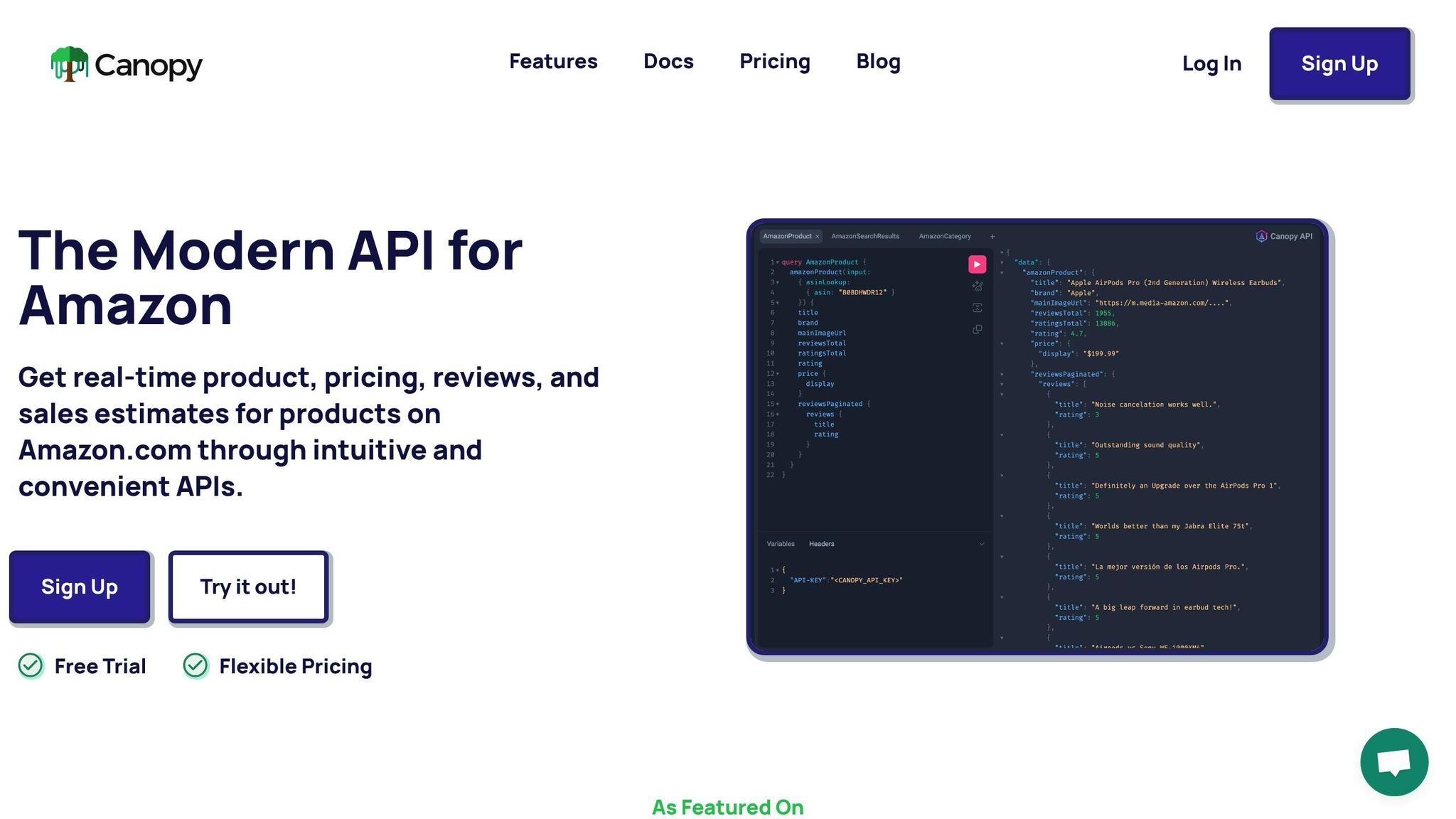
To get started, visit canopyapi.co to sign up. Once you've completed the signup process, you'll find your API key in the product dashboard. This key is critical - it’s required to authenticate all your requests across both the REST and GraphQL endpoints.
Once these prerequisites are ready, you're all set to move on to authentication and configuration.
Authentication and Configuration
Setting up authentication is straightforward. After grabbing your API key from the dashboard, include it in every request using the API-KEY header. This method works seamlessly for both REST and GraphQL endpoints.
Here’s where to find the endpoints:
- REST Endpoint:
https://rest.canopyapi.co - GraphQL Endpoint:
https://graphql.canopyapi.co
Since both endpoints use the same authentication method, you can easily switch between them without altering your code for authentication.
For users in the U.S., the Canopy API simplifies localization. By setting the domain parameter to "US" (the default), the API automatically formats data for U.S. preferences. This includes:
- Prices displayed in USD with the
$symbol - Dates formatted as MM/DD/YYYY
- Measurements using imperial units
Here’s a quick example of how to set up authentication in JavaScript:
const API_KEY = 'your-api-key-here';
const REST_ENDPOINT = 'https://rest.canopyapi.co';
const GRAPHQL_ENDPOINT = 'https://graphql.canopyapi.co';

const headers = {
  'API-KEY': API_KEY,
  'Content-Type': 'application/json'
};
Once your API key is active (immediately after signing up), you can start integrating the Canopy REST or GraphQL API into your project. This setup ensures you can quickly get to work on building dynamic search features without unnecessary delays.
Implementing Dynamic Search with Canopy REST API
The Canopy REST API offers a simple way to create dynamic search features that respond to user input in real time.
Building a REST API Search Query
To set up a dynamic search query, you’ll use the /api/amazon/search endpoint. The key parameter here is searchTerm, which takes the user’s keyword input and is mandatory for all searches. By combining this with other filtering options, you can create highly specific searches.
Here’s a breakdown of the key parameters:
- searchTerm: The main keyword or phrase the user wants to search for (required).
- categoryId: Filters results to specific Amazon categories, such as electronics or books.
- minPrice and maxPrice: Define a price range in USD.
- page: Manages pagination, typically returning 20-40 products per page.
- sort: Specifies how results are ordered, with options like
FEATURED,PRICE_ASCENDING,PRICE_DESCENDING, orAVERAGE_CUSTOMER_REVIEW. - conditions: Filters products by condition using options such as
NEW,USED, orRENEWED.
These parameters allow users to refine their searches instantly based on their preferences. For instance, if someone is looking for new wireless headphones under $100, the query might look like this: searchTerm=wireless headphones&maxPrice=100&conditions=NEW.
Once you’ve built your query, the next step is to send the request and work with the results.
Requesting and Parsing Results
After constructing the query, you can make an HTTP GET request to fetch the data. The Canopy REST API uses standard HTTP GET methods, and every request requires an API key in the API-KEY header for authentication. The API responds with JSON data, making it easy to parse.
The response includes a data object containing amazonProductSearchResults, which is divided into two main sections: productResults and availableRefinements. The productResults array provides essential details about each product, including:
- title: The product name as listed on Amazon.
- price: An object with the price value, currency symbol ($), and a formatted display string.
- rating: The product’s customer review score.
- ratingsTotal: Total number of customer ratings.
- mainImageUrl: URL of the product's primary image.
- asin: Amazon’s unique product identifier.
- isPrime: Indicates if the product is eligible for Prime shipping.
Pagination details are included in the pageInfo object, which provides information such as currentPage, totalPages, hasNextPage, and hasPrevPage. This is especially helpful for creating navigation controls.
Code Example for REST Search
Here’s a JavaScript example that demonstrates how to implement dynamic search functionality:
const API_KEY = 'your-api-key-here';
const REST_ENDPOINT = 'https://rest.canopyapi.co';

async function searchAmazonProducts(searchParams) {
  // Build query string from parameters
  const queryParams = new URLSearchParams();

  if (searchParams.searchTerm) {
    queryParams.append('searchTerm', searchParams.searchTerm);
  }

  if (searchParams.categoryId) {
    queryParams.append('categoryId', searchParams.categoryId);
  }

  if (searchParams.minPrice) {
    queryParams.append('minPrice', searchParams.minPrice);
  }

  if (searchParams.maxPrice) {
    queryParams.append('maxPrice', searchParams.maxPrice);
  }

  if (searchParams.conditions) {
    queryParams.append('conditions', searchParams.conditions);
  }

  if (searchParams.sort) {
    queryParams.append('sort', searchParams.sort);
  }

  if (searchParams.page) {
    queryParams.append('page', searchParams.page);
  }

  try {
    const response = await fetch(
      `${REST_ENDPOINT}/api/amazon/search?${queryParams.toString()}`,
      {
        headers: {
          'API-KEY': API_KEY,
          'Content-Type': 'application/json'
        }
      }
    );

    if (!response.ok) {
      throw new Error(`HTTP error! status: ${response.status}`);
    }

    const data = await response.json();
    return data.data.amazonProductSearchResults;

  } catch (error) {
    console.error('Search request failed:', error);
    throw error;
  }
}

// Example usage with dynamic parameters
async function handleUserSearch() {
  const searchParams = {
    searchTerm: 'bluetooth speakers',
    maxPrice: 150,
    conditions: 'NEW',
    sort: 'AVERAGE_CUSTOMER_REVIEW',
    page: 1
  };

  try {
    const results = await searchAmazonProducts(searchParams);

    // Display product results
    results.productResults.results.forEach(product => {
      console.log(`${product.title}`);
      console.log(`Price: ${product.price.display}`);
      console.log(`Rating: ${product.rating} (${product.ratingsTotal} reviews)`);
      console.log(`Prime: ${product.isPrime ? 'Yes' : 'No'}`);
      console.log(`Image: ${product.mainImageUrl}`);
      console.log('---');
    });

    // Handle pagination
    const pageInfo = results.productResults.pageInfo;
    console.log(`Page ${pageInfo.currentPage} of ${pageInfo.totalPages}`);
    console.log(`Has next page: ${pageInfo.hasNextPage}`);

  } catch (error) {
    console.error('Failed to fetch search results:', error);
  }
}
This script dynamically builds query strings based on user preferences, handles API responses, and processes product data for display. It also includes error handling and pagination controls, making it a solid foundation for creating a responsive search interface.
Implementing Dynamic Search with Canopy GraphQL API
The GraphQL API, much like the REST approach, simplifies dynamic search by offering fine-tuned query capabilities. With the Canopy GraphQL API, you can request exactly the product data you need in a single query. This reduces the number of API calls while giving you precise control over the structure of the response.
Creating a GraphQL Search Query
Dynamic search queries in GraphQL use the amazonProductSearchResults operation, which takes variables to make searches customizable. The core of the query lies in the input parameter, where you define your search criteria.
Key variables include:
- searchTerm (required): Specifies the product or keyword to search for.
- domain: Defaults to the US but can be adjusted for other regions.
- categoryId: Filters results by specific Amazon categories.
- refinements: Adds advanced filtering options like condition (
NEW,USED,RENEWED), price range, and more.
Here’s an example of a basic GraphQL query structure:
query SearchProducts($input: AmazonProductSearchResultsInput!) {
  amazonProductSearchResults(input: $input) {
    productResults(input: { page: 1, sort: FEATURED }) {
      results {
        title
        asin
        price {
          display
          value
          currency
          symbol
        }
        rating
        ratingsTotal
        mainImageUrl
        isPrime
        sponsored
      }
      pageInfo {
        currentPage
        totalPages
        hasNextPage
        hasPrevPage
      }
    }
    availableRefinements {
      name
      options {
        name
      }
    }
  }
}
The variables for this query might look like this:
{
  "input": {
    "searchTerm": "wireless headphones",
    "domain": "US",
    "refinements": {
      "conditions": ["NEW"],
      "priceRange": {
        "max": 200
      }
    }
  }
}
This query structure is flexible enough to include additional product details without requiring extra API calls.
Retrieving Nested Product Data
Canopy's GraphQL API allows you to pull detailed product information, such as reviews, stock levels, and sales estimates, directly within your query. This makes it easy to build rich search interfaces that provide users with comprehensive product insights.
For example, you can extend the amazonProductSearchResults query to include nested data like product variants, technical specifications, and customer reviews. Here's an expanded query:
query DetailedSearch($input: AmazonProductSearchResultsInput!) {
  amazonProductSearchResults(input: $input) {
    productResults(input: { page: 1, limit: 20 }) {
      results {
        title
        asin
        brand
        price {
          display
          value
          currency
        }
        recommendedRetailPrice {
          display
          value
        }
        rating
        ratingsTotal
        reviewsTotal
        mainImageUrl
        imageUrls
        isPrime
        isNew
        featureBullets
        categories {
          name
          breadcrumbPath
        }
        seller {
          name
          sellerId
        }
        variants {
          asin
          text
          price {
            display
          }
          attributes {
            name
            value
          }
        }
        topReviews {
          title
          body
          rating
          verifiedPurchase
          reviewer {
            name
          }
        }
      }
    }
  }
}
This approach ensures that you can retrieve all relevant product details in a single query, saving time and resources.
Code Example for GraphQL Search
Here’s a JavaScript implementation of a dynamic search using Canopy's GraphQL API:
const API_KEY = 'your-api-key-here';
const GRAPHQL_ENDPOINT = 'https://graphql.canopyapi.co';

const SEARCH_QUERY = `
  query SearchProducts($input: AmazonProductSearchResultsInput!, $productInput: AmazonProductSearchResultsProductResultsInput) {
    amazonProductSearchResults(input: $input) {
      productResults(input: $productInput) {
        results {
          title
          asin
          brand
          price {
            display
            value
            currency
            symbol
          }
          rating
          ratingsTotal
          mainImageUrl
          isPrime
          sponsored
          featureBullets
          categories {
            name
            breadcrumbPath
          }
          seller {
            name
            sellerId
          }
        }
        pageInfo {
          currentPage
          totalPages
          hasNextPage
          hasPrevPage
        }
      }
      availableRefinements {
        name
        options {
          name
        }
      }
    }
  }
`;

async function searchAmazonProductsGraphQL(searchParams) {
  const input = {
    searchTerm: searchParams.searchTerm,
    domain: searchParams.domain || 'US'
  };

  if (searchParams.categoryId) {
    input.categoryId = searchParams.categoryId;
  }

  const refinements = {};

  if (searchParams.conditions) {
    refinements.conditions = Array.isArray(searchParams.conditions)
      ? searchParams.conditions
      : [searchParams.conditions];
  }

  if (searchParams.minPrice || searchParams.maxPrice) {
    refinements.priceRange = {};
    if (searchParams.minPrice) refinements.priceRange.min = searchParams.minPrice;
    if (searchParams.maxPrice) refinements.priceRange.max = searchParams.maxPrice;
  }

  if (Object.keys(refinements).length > 0) {
    input.refinements = refinements;
  }

  const productInput = {
    page: searchParams.page || 1
  };

  if (searchParams.limit) {
    productInput.limit = searchParams.limit;
  }

  if (searchParams.sort) {
    productInput.sort = searchParams.sort;
  }

  const variables = {
    input,
    productInput
  };

  try {
    const response = await fetch(GRAPHQL_ENDPOINT, {
      method: 'POST',
      headers: {
        'Content-Type': 'application/json',
        'API-KEY': API_KEY
      },
      body: JSON.stringify({
        query: SEARCH_QUERY,
        variables
      })
    });

    if (!response.ok) {
      throw new Error(`HTTP error! status: ${response.status}`);
    }

    const result = await response.json();

    if (result.errors) {
      throw new Error(`GraphQL errors: ${JSON.stringify(result.errors)}`);
    }

    return result.data.amazonProductSearchResults;
  } catch (error) {
    console.error('GraphQL search request failed:', error);
    throw error;
  }
}

// Example usage
async function handleDynamicGraphQLSearch() {
  const searchParams = {
    searchTerm: 'gaming laptop',
    conditions: ['NEW'],
    minPrice: 800,
    maxPrice: 2000,
    sort: 'AVERAGE_CUSTOMER_REVIEW',
    page: 1,
    limit: 25
  };

  try {
    const results = await searchAmazonProductsGraphQL(searchParams);

    results.productResults.results.forEach(product => {
      console.log(`Product: ${product.title}`);
      console.log(`Brand: ${product.brand || 'N/A'}`);
      console.log(`Price: ${product.price?.display || 'Price unavailable'}`);
      console.log(`Rating: ${product.rating} (${product.ratingsTotal} reviews)`);
      console.log(`Prime: ${product.isPrime ? 'Yes' : 'No'}`);

      if (product.seller) {
        console.log(`Seller: ${product.seller.name}`);
      }

      if (product.categories && product.categories.length > 0) {
        console.log(`Category: ${product.categories[0].breadcrumbPath}`);
      }
    });
  } catch (error) {
    console.error('Error during search:', error);
  }
}
This example demonstrates how to build a dynamic search query, handle refinements, and process results effectively.
sbb-itb-d082ab0
Best Practices and Troubleshooting
Creating a high-performing dynamic search application with the Canopy API hinges on fine-tuning API parameters. By focusing on pagination, field selection, and request batching, you can improve performance while keeping costs under control.
Optimizing API Usage
Progressive Pagination
Load results in chunks of 20–40 per page. This strikes a good balance between delivering complete data and maintaining quick response times.
Selective Field Requests
When building GraphQL queries, only request the fields your application actually needs. This approach reduces payload sizes and speeds up responses by avoiding unnecessary data retrieval.
Cost Efficiency for High Volumes
As your usage grows, focus on making targeted API calls. Canopy API offers volume discounts, with costs dropping from $0.01 to $0.004 per request depending on usage levels.
Batching Requests with GraphQL
Take advantage of GraphQL's ability to nest queries. By consolidating multiple requests into a single API call, you can significantly reduce the total number of calls required.
Common Issues and Solutions
Even with optimized usage, some common errors may arise. Here’s how to tackle them:
Authentication Problems
If you receive a 401 Unauthorized error, check your API key. Ensure it's included correctly in the API-KEY header.
Rate Limit Challenges
Frequent requests might trigger rate-limiting responses. To handle this, implement exponential backoff strategies, such as retrying after 1 second, then 2 seconds, and so on.
Scalability and Localization Considerations
As your application grows, keep scalability and localization in mind to meet user expectations effectively.
Tailoring for the US Market
Ensure all user-facing data aligns with US standards. Use the dollar sign for prices (e.g., $1,299.99), the MM/DD/YYYY format for dates, and imperial units for measurements like weight and dimensions. This attention to detail enhances user experience for a US-based audience.
Conclusion
Dynamic search has proven to be a game-changer for integrating real-time Amazon data into applications. By using keyword-driven search, developers can tap into Amazon's vast marketplace data with ease. The Canopy API simplifies what was once a labor-intensive process, turning it into a smooth and efficient development experience.
Key Points Recap
Dynamic search shines in its ability to provide real-time product insights at scale. With access to millions of products spanning thousands of categories, the Canopy API removes the need for unreliable scrapers, letting developers focus on building innovative applications instead of maintaining fragile systems.
REST and GraphQL offer flexibility for various use cases - whether you need quick, straightforward searches or more advanced, nested queries. This adaptability is crucial for applications that pull diverse data, such as pricing, reviews, sales estimates, and inventory levels.
The scalability of Canopy API is another standout feature. Its pricing structure grows with usage, rewarding high-volume operations. With over 10,000 daily cache hits, the API is built to handle heavy traffic without breaking a sweat.
"Focus on development instead of maintaining scrapers."
Localization for the US market - such as dollar-based pricing and imperial measurements - ensures search results align with user expectations. Features like precise error handling, progressive pagination, and accurate data retrieval create a solid foundation for building scalable Amazon-focused tools.
With a developer-first approach, the Canopy API makes integration straightforward. Comprehensive documentation and open-source examples allow most teams to implement dynamic search functionality in minutes rather than weeks. Combined with AI-powered data insights, this positions the Canopy API as a modern, efficient solution for Amazon product data integration.
FAQs
How does the Canopy API help businesses track Amazon product prices and availability in real time?
The Canopy API provides instant access to Amazon product data, such as pricing, availability, and detailed product descriptions. This capability enables businesses to track changes as they happen and make smarter, data-driven decisions.
With its flexible and straightforward GraphQL and REST APIs, the Canopy API simplifies data retrieval. It helps businesses stay ahead by keeping an eye on trends and adapting quickly to market changes.
What benefits does GraphQL offer over REST for dynamic search queries with the Canopy API?
GraphQL offers a range of benefits when working with dynamic search queries through the Canopy API. Unlike REST, GraphQL lets you request only the data you need in a single query. This eliminates the common issues of over-fetching or under-fetching data, streamlining performance and making integration with your application much smoother.
Its flexible query structure is particularly useful for managing complex, keyword-based searches. With GraphQL support in the Canopy API, you can efficiently pull real-time Amazon product data - like pricing, reviews, and search results - customized to meet your specific needs.
How can I optimize API usage and manage rate limits effectively when integrating the Canopy API into my application?
To make the most of your Canopy API integration and avoid hitting rate limits, start by thoroughly reviewing the API documentation. Understanding the usage limits and guidelines will help you design your application to operate within the set thresholds.
You can implement smart strategies like caching frequently accessed data to minimize unnecessary API calls and improve response times. For handling large datasets, pagination is a must - it keeps requests manageable and prevents overload. It's also a good idea to monitor your API usage regularly and set up alerts to catch potential issues before they escalate.
If you're expecting high traffic or sudden usage spikes, it’s worth contacting Canopy API support. They can work with you to explore custom rate limit solutions that fit your specific needs.