How Best Sellers Rank relates to a unit sales estimate
Best Sellers Rank is a category rank, not a unit count. How a monthly unit estimate is derived from that rank, what the weekly and annual figures mean, and where the estimate stops.
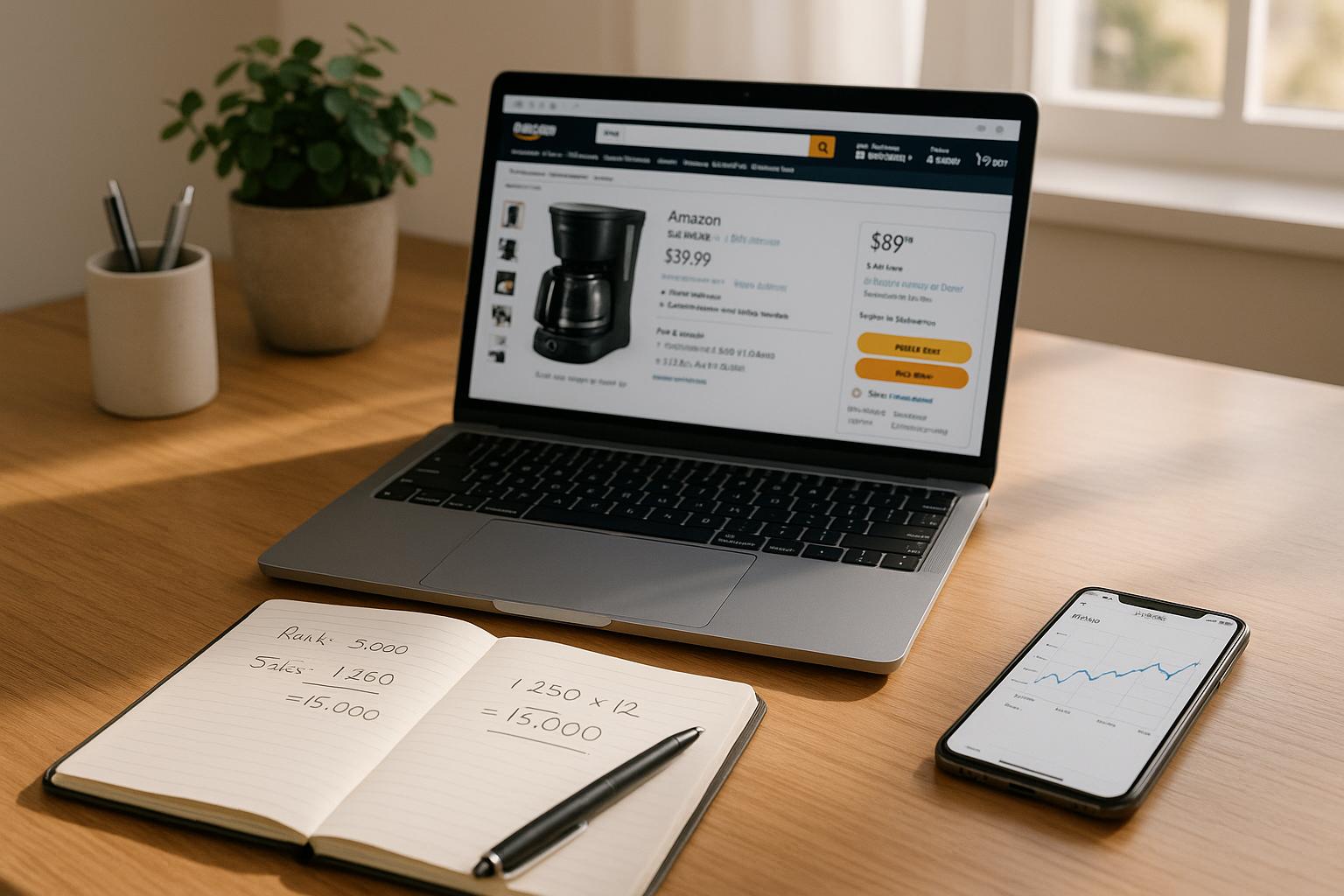
Amazon does not publish how many units a product sold. Best Sellers Rank is a rank inside a category. A lower number means the product has been selling more recently than others in that same category. It is not a unit count, and the same rank means different volumes in different categories.
To see an estimate for a specific product, use the Amazon sales estimator. Paste an ASIN. You get estimated monthly unit sales, plus the Best Sellers Rank and category on the listing. This page explains what that number is and where it stops being useful. The same three fields over REST and GraphQL are on the Amazon sales data API page.
What you get back
The estimate is three integers:
- monthlyUnitSales is the estimate of units for a month. The other two figures are derived from it.
- weeklyUnitSales is that monthly estimate divided by 4.33 and rounded to the nearest integer.
- annualUnitSales is the monthly estimate multiplied by 12. That is an extrapolation, not a count of the past year.
A monthly estimate of 750 would show as 173 weekly and 9000 annual. Those numbers are only there so the arithmetic is easy to check. They are not a live product. A live ASIN returns its own estimate. There is no revenue field.
How the monthly figure is produced
monthlyUnitSales comes from a model. The primary signal is the first Best Sellers Rank on the listing: the category name and the rank. When the product page shows a recent-sales phrase such as “700+ bought in past month,” that phrase refines the monthly figure. The number in the phrase is a rounded threshold. “700+” means the estimate sits above 700 and below 800, because a higher band would be shown as “800+”. A listing with only the phrase, and no rank, is estimated from the phrase alone.
The same category, rank, and recent-sales text are reused for up to 48 hours. Looking up the same product again a few minutes later will not produce a new estimate.
If the listing has neither a Best Sellers Rank nor a recent-sales phrase, or an estimate cannot be produced, the result is null. The field is experimental, so it can be missing more often than title or price.
There is no curve on this page that you can apply to a rank by hand. Two products with the same rank in different categories are not estimated as the same volume. The category finder shows every rank on a listing if you want the categories without a unit estimate. For title, price, and rating, use ASIN lookup.
Where the estimate is weak
- Rank is relative. A rank of 200 in a large category and a rank of 200 in a small category are not the same demand. Compare ranks only inside one category.
- Rank moves. Promotions, stockouts, and seasonality change it through the day. One lookup is a snapshot.
- The “bought in past month” phrase is a band, not an exact count.
- Weekly and annual figures are arithmetic on the monthly estimate. They are not separate measurements.
- This is not Seller Central order data, not revenue, and not a history of past ranks. Save each response yourself if you need a series.
The tools page has the rest of the free lookups, including keyword rank and bestsellers.
When to use the API
The free estimator is for a handful of ASINs. There is a daily limit per IP, and it does not require a key. For a catalog, use the Amazon sales data API.
REST is GET /api/amazon/product/sales on rest.canopyapi.co, with the key in the API-KEY header. Pass exactly one of asin, url, or gtin. The general product route does not include salesEstimate. GraphQL is amazonProduct at graphql.canopyapi.co, and the same query can select bestSellerRankings.
query GetAmazonSalesEstimate($input: AmazonProductInput!) {
  amazonProduct(input: $input) {
    asin
    bestSellerRankings { categoryName rank }
    salesEstimate {
      weeklyUnitSales
      monthlyUnitSales
      annualUnitSales
    }
  }
}
Asking for a sales estimate counts as an additional request per product. Every account includes 100 free requests a month, then usage is billed per request starting at $0.01, with automatic volume discounts and no monthly minimum. Create a key after you sign in. Field reference is in the docs.
FAQ
Can Best Sellers Rank tell you exact unit sales?
No. A rank orders products inside a category. It does not count orders. The estimate built on it is an approximation of unit demand. The monthly figure follows the listing’s Best Sellers Rank, its category, and the recent-sales phrase when Amazon shows one. Treat it as a way to compare products. Expect it to miss a promotion, a stockout, or a seasonal spike that the rank has not settled into yet. It will not match the order report in Seller Central.
Why does the same rank mean different sales in different categories?
Best Sellers Rank is calculated inside a category, and categories differ in size. A product can hold a different rank in each category Amazon lists it under. The sales estimate uses the first rank on the listing. A strong rank in a small category can mean fewer units than a weaker rank in a large one. The category finder shows every rank on the listing.
What does a null sales estimate mean?
The estimate is null when the listing has neither a Best Sellers Rank nor a recent-sales phrase, or when an estimate cannot be produced. Some products never show a rank. A null result is a normal response, not a failed product lookup. You can still read the title and price from ASIN lookup.