10 Chat GPT App ideas using our MCP Server
How MCP servers connect ChatGPT to external tools for Amazon seller workflows—real-time product research, repricing, review analysis, and automated compliance.

The Model Context Protocol (MCP) has transformed how developers build ChatGPT applications. By acting as a universal connector, MCP eliminates the need for custom integrations, allowing AI to interact with tools like databases, APIs, and payment systems in real-time. This approach simplifies workflows and enables ChatGPT to perform complex tasks, from competitive pricing to customer insights.
Key Takeaways:
- Amazon Product Research: Analyze Amazon product data for real-time trends and pricing insights using the Canopy API.
- Seller Tools: Automated repricing and AI-driven listing optimization.
- Customer Insights: Turn reviews into actionable feedback and detect trends across platforms.
- Compliance: Automate audits for Amazon listings while ensuring data privacy.
Why MCP Matters:
MCP standardizes how ChatGPT interacts with external services, making it faster and easier to build apps that analyze data, automate tasks, and streamline operations. From pricing adjustments in under three minutes to processing 50,000 reviews in 13 minutes, MCP-powered apps redefine efficiency.
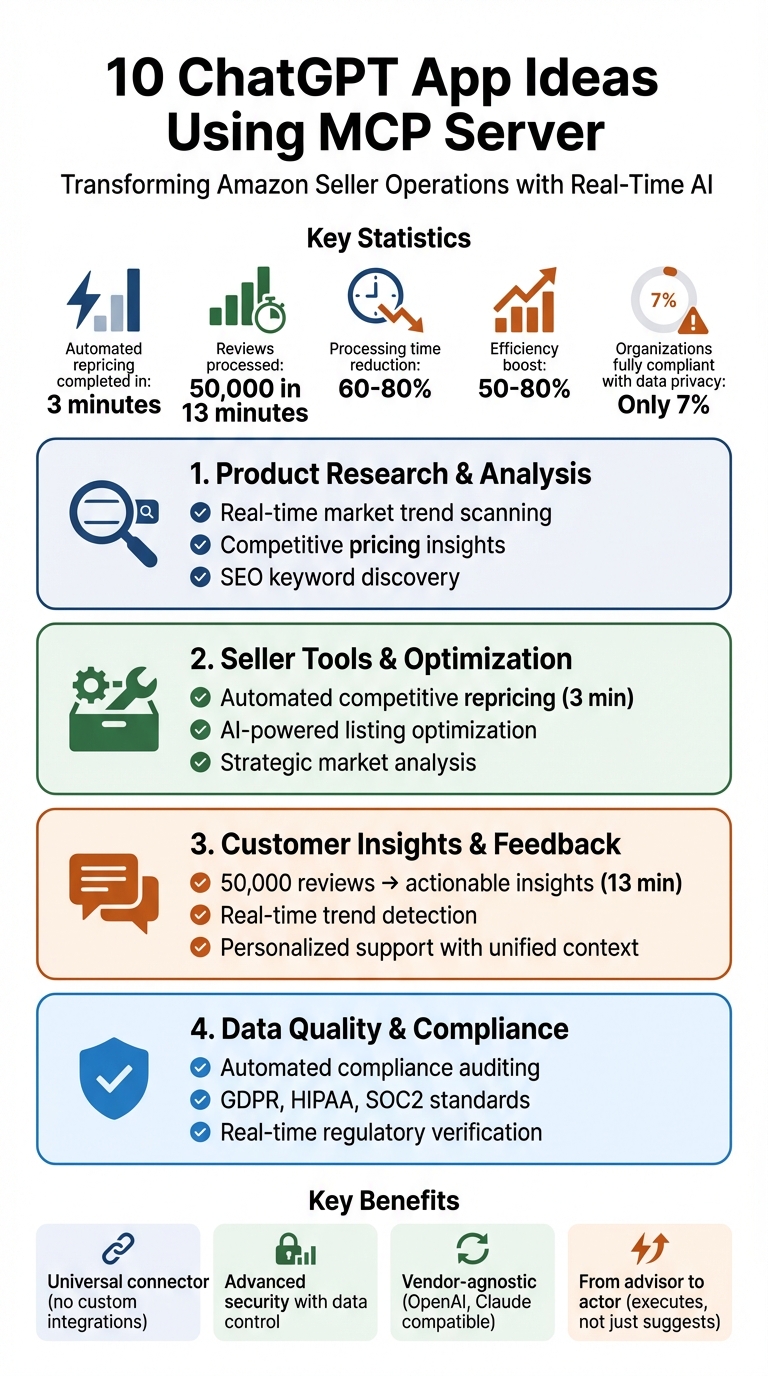
10 MCP-Powered ChatGPT Applications for Amazon Sellers: Key Statistics and Use Cases
1. Amazon Product Research and Analysis
Spotting Trends with Real-Time Market Scanning
By connecting ChatGPT to the Canopy API through the MCP server, you can identify high-demand Amazon products in real time. The search_products(query, max_results) tool allows you to search for products using keywords, providing details like product names, prices, ratings, and review counts. ChatGPT then analyzes this data to identify products with high review activity - those with a large number of reviews and strong ratings often signal significant demand. For instance, you can refine the results to show only the top five products. This kind of real-time insight lays the groundwork for deeper competitive benchmarking with Amazon data.
Competitive Pricing Insights
After identifying trending products, analyzing their pricing becomes the next step. You can build an app that uses Amazon pricing data to automate pricing gap analysis. With the scrape_product(product_url) tool, ChatGPT can extract details such as price, availability, and customer feedback. The system can highlight products that are priced noticeably higher or lower than the average, helping you identify opportunities or potential pricing issues. This approach eliminates the need for complicated scraping processes or authentication hurdles.
"MCP significantly reduces the friction of building products that interact with external services, allowing you to tie different services together seamlessly." - OpenAI
Discovering SEO Keywords
To enhance product visibility, you can create a workflow where ChatGPT identifies high-performing keywords from top-ranking Amazon listings. Start by using the search_products(query, max_results) tool to find the top 10 products for a specific keyword. Then, apply the scrape_product(product_url) tool to analyze their titles, descriptions, and customer reviews. Customer reviews, in particular, are a goldmine for uncovering long-tail keywords, as they reflect the language buyers naturally use to describe products. The MCP server simplifies this process by eliminating the need for API keys, enabling you to map keywords at scale.
2. Amazon Seller Tools and Optimization
Automated Competitive Repricing
Developers Ajeet Singh Raina and Sundeep Gottipati showcased a "Competitive Repricing Agent" powered by multiple MCP servers. This agent works by scraping live prices from platforms like Amazon, Walmart, and Best Buy using Firecrawl. It then compares these prices to the seller's Stripe listings, calculates an updated price, and applies the changes to the Stripe product - all in just three minutes. To ensure transparency, the system logs every decision, creating a detailed audit trail. This setup moves ChatGPT beyond merely suggesting pricing strategies to actively implementing them across sales channels.
"Only MCP can execute: creating payment links, generating invoices, storing data in your database, and pushing to your GitHub. That's the difference between an advisor and an actor." – Ajeet Singh Raina and Sundeep Gottipati, Docker
With dynamic pricing as a foundation, sellers can also enhance their listings through AI-driven content updates.
Listing Optimization with AI-Powered Keyword Rewriting
You can create apps that automatically refine Amazon listings using an MCP server equipped with a vector store of top-performing keywords. By analyzing competitor listings, the system identifies the most effective keywords and rewrites titles and descriptions to improve SEO. This eliminates the need for custom API wrappers and ensures your listings stay competitive.
Strategic Market Analysis Before Repricing
Pricing automation becomes even more effective when paired with thorough market analysis. The Sequential Thinking MCP enables sellers to examine trends like competitor price spikes before adjusting their own prices. This method helps avoid reactive decisions by allowing ChatGPT to evaluate complex scenarios - such as determining whether a competitor's price hike reflects increased demand or a temporary stock shortage. By combining competitor pricing data, historical sales trends, and statistical insights, the system advises whether to align with market shifts or maintain your current strategy.
3. Customer Insights and Feedback
Turning Reviews into Actionable Insights with RAG
Imagine an app that takes thousands of Amazon reviews and turns them into actionable steps. That’s exactly what phData’s RAG (retrieval-augmented generation) solution achieved. In July 2024, it processed 50,000 Amazon reviews in just 13 minutes, leading to three distinct projects: a UI/UX Optimization (completed in 4 weeks), a Performance Enhancement (4 weeks), and a Feature Expansion (3 weeks). The AI didn’t just summarize feedback - it pinpointed specific tasks like "implementing a flexible search bar" or "optimizing video playback" based on user complaints.
"By tokenizing and storing reviews in a vector database, we can leverage retrieval-augmented generation (RAG) to pinpoint relevant reviews." – Ryan Gooch, phData
Using "search" and "fetch" tools, MCP servers work alongside ChatGPT to group related feedback and highlight the most impactful reviews using metadata filters. This process doesn’t just analyze reviews; it lays the groundwork for integrating real-time customer trends into decision-making.
Detecting Customer Trends in Real Time
While review analysis provides a snapshot, real-time trend detection takes it to the next level by monitoring multiple data streams simultaneously. By linking ChatGPT to MCP servers, you can query platforms like Shopify, Salesforce, and Klaviyo to uncover emerging trends as they happen. Acting as a central hub, the system pulls live data from otherwise disconnected systems. It can even automate anomaly detection by querying analytics APIs, helping you understand sudden drops in metrics like conversion rates in a specific region.
Personalized Support Through Unified Customer Context
To complement trend detection, personalized customer support taps into unified customer data for more tailored interactions. With MCP, you can create apps that pull a customer’s interaction history to deliver responses that feel personal. AI assistants can greet users by name, reference past purchases, and provide troubleshooting steps tailored to their product version. Companies using MCP for document processing have reported cutting processing times by 60–80%. Additionally, by combining feedback from platforms like Zendesk, Shopify, and Klaviyo, the system can identify recurring issues and automatically craft personalized solutions.
This level of customization ensures customers feel heard and valued, while businesses gain efficiency and actionable insights.
sbb-itb-d082ab0
4. Data Quality and Compliance
Automated Compliance Auditing for Amazon Listings
Imagine an app that audits Amazon product data against regulatory standards, all while safeguarding sensitive information. That’s where MCP servers come in. These servers ensure data privacy by masking or filtering sensitive details before handing them off to ChatGPT. This is crucial, especially when you consider that only 7% of organizations are fully compliant with data privacy regulations for their test data.
MCP servers can cross-check product listings with Amazon's style guides and regulatory requirements in real time. They flag non-compliant content before it goes live. For instance, the server can confirm that product descriptions adhere to necessary standards and verify that items include essential safety certifications. If any regulatory details are missing, the system pauses and prompts users to provide the required information before moving forward.
"MCP has quickly emerged as the standard to make that possible [feeding LLMs with structured, contextual information at runtime]." – Iris Zarecki, Product Marketing Director, K2view
To enhance compliance and accuracy, you can deploy specialized tools. Use dedicated search and fetch tools to retrieve product records and their documentation for verification. Additionally, dynamic filtering tools can limit AI agents' access to sensitive operations, based on user roles or the associated risk levels.
Centralized gateways also play a key role by logging every correction made to product data. These logs ensure compliance with GDPR, HIPAA, and SOC2 standards. By maintaining a complete record of changes, this approach turns compliance into an automated and efficient process, rather than a daunting challenge.
How AI Agents Just Changed Amazon FBA Forever (Full MCP Setup Guide)
Conclusion
Developing ChatGPT applications with MCP servers opens the door to seamless integration with Amazon product data. Instead of relying on outdated or static information, your applications can pull real-time market data directly from sources like the Canopy API or alternatives to Amazon's official API. This upgrade transforms ChatGPT from a simple text generator into a proactive tool - capable of initiating workflows, updating inventory, and managing complex, multi-step operations.
These integrations don't just streamline processes - they redefine them. Tasks that once took hours can now be completed in mere minutes. Organizations and marketers have reported efficiency boosts ranging from 50% to 80%. These are not small tweaks; they're game-changing improvements, turning raw data into actionable insights faster than ever before.
"MCP servers represent a fundamental shift in how entrepreneurs can interact with their essential business tools - one where AI assistants serve as intelligent interfaces to critical services rather than just conversational partners." – Stephen Thoemmes, Snyk
MCP's standardized connectivity ensures flexibility - you’re not tied to a single vendor. Build your server once, and it seamlessly integrates with platforms like OpenAI and Claude. On top of that, you get advanced security features while retaining full control over your data. This combination of adaptability and control makes MCP servers a powerful foundation for next-generation AI applications.
FAQs
How does the MCP server enhance the performance of ChatGPT applications?
The MCP server simplifies the development of ChatGPT applications by serving as a centralized hub for connecting external tools, APIs, and databases. It standardizes these connections by defining each feature as a reusable "tool" with clear input and output guidelines. This setup not only saves developers time but also makes maintenance more straightforward. Instead of building custom integrations for every use case, developers can rely on this streamlined approach to speed up the development process.
Beyond integration, the MCP server takes care of essential tasks like tool discovery, authentication, and logging, ensuring high levels of security and compliance suited for enterprise needs. During runtime, it provides structured data (like JSON or UI templates) directly to ChatGPT, enabling dynamic, interactive outputs without causing delays. Features such as built-in caching and background processing further minimize latency, letting the model focus on reasoning while the server handles resource-heavy operations like database queries or API interactions.
By centralizing these processes, enhancing security, and managing demanding tasks, the MCP server empowers developers to build scalable, dependable, and efficient ChatGPT-driven applications with minimal hassle.
How does using an MCP server simplify Amazon product research and analysis?
Using an MCP server simplifies Amazon product research by offering a single, intuitive interface that fetches live product data - no API keys or complicated authentication required. With just a few straightforward function calls like search_products or scrape_product, you can search for products by keyword and access detailed information, such as the product name, price (e.g., $29.99), image URL, ratings, review count, availability, and full descriptions.
The server works effortlessly with AI tools like ChatGPT, allowing for follow-up questions, competitor analysis, and real-time insights. This eliminates the hassle of building custom API wrappers, saving time when developing tools for tasks like price tracking, review evaluation, or inventory monitoring. Additionally, its open-source framework gives you complete control over deployment and scaling, transforming manual research into a streamlined, automated process tailored to meet the needs of U.S.-based e-commerce.
How does MCP ensure data privacy and regulatory compliance?
MCP (Model Context Protocol) is built on a secure, standards-based framework that empowers developers to manage data access with precision. It incorporates custom authentication methods and detailed access controls, ensuring that every tool operates within a secure, isolated environment to reduce the risk of unauthorized data exposure.
To bolster compliance, MCP deployments come equipped with enterprise-level governance features. These include OAuth-protected gateways, comprehensive audit logs, and adaptable policies. These tools are designed to align with key industry standards, such as SOC 2, HIPAA, and GDPR, helping organizations adhere to regulatory requirements while limiting data access strictly to what is necessary.