Top 7 Amazon Review APIs for 2025
Compare the top Amazon review APIs in 2025 — real-time data access, transparent pricing, and easy integration to find the right fit.

Looking for the best Amazon review APIs in 2025? Here's a quick rundown of the top options to help you access real-time review data, streamline your processes, and make informed business decisions.
Key Takeaways:
- Canopy API: Transparent pricing, real-time data via REST and GraphQL, AI-driven insights, and flexible plans starting from free to enterprise-level.
- AMZScout, Keepa, Jungle Scout, Helium 10, SellerApp, DataHawk: Limited public details on features, pricing, and integration. Direct contact is required for specifics.
Why It Matters:
Accessing Amazon reviews through APIs saves time, eliminates the need for unreliable scrapers, and provides structured data to improve product strategies. Canopy API stands out for its clear documentation and flexible pricing, while others require further investigation.
Quick Tip: Choose an API based on your need for real-time data, ease of integration, and scalability. Below is a detailed breakdown of each API.
1. Canopy API
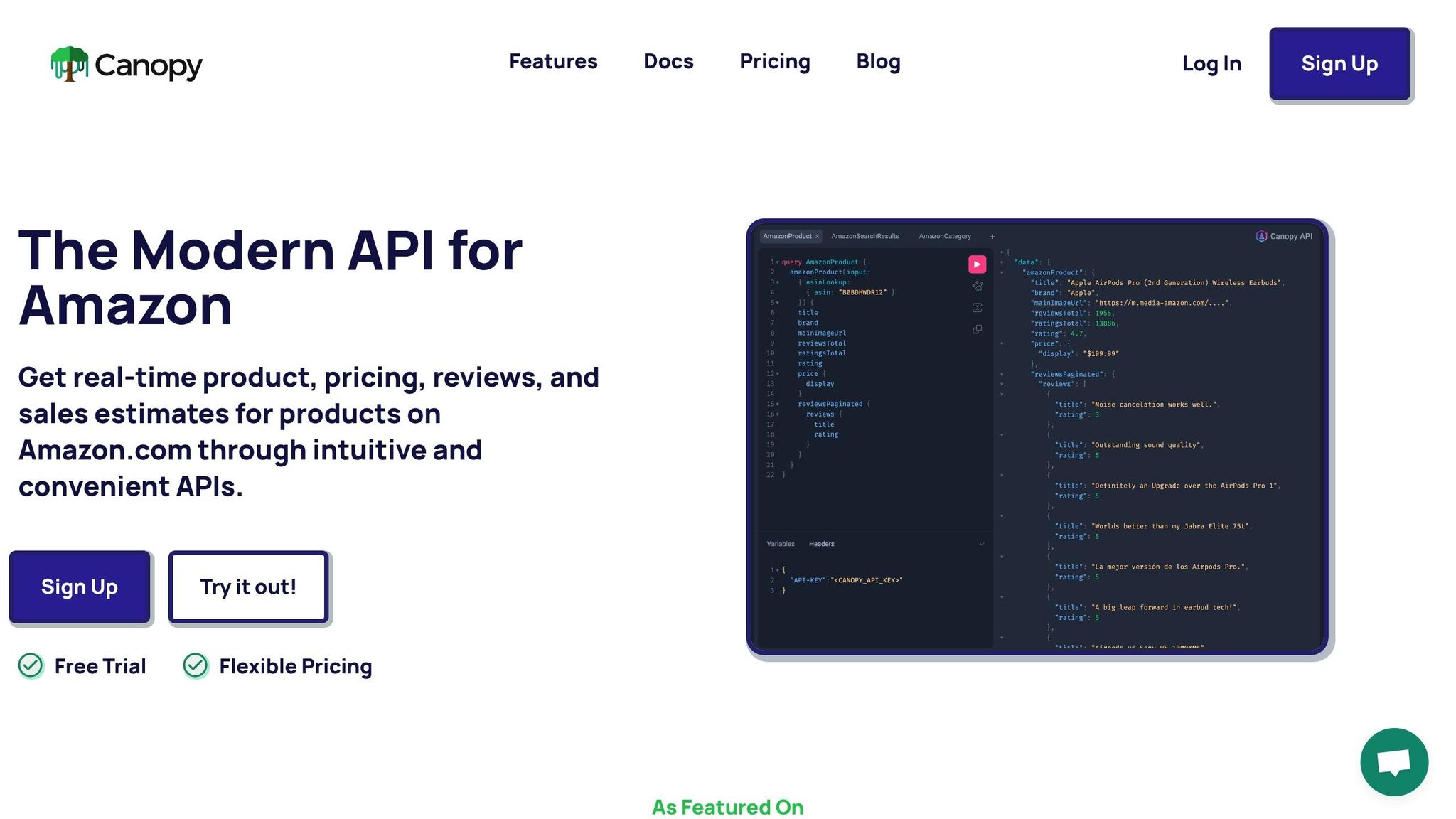
The Canopy API provides real-time access to Amazon product reviews through both REST and GraphQL endpoints. It enables developers to access Amazon data, including reviews, product details, pricing, and sales estimates, without the hassle of building custom scrapers. Its AI-driven infrastructure ensures fast data processing, making it easier for businesses to gather and analyze review information effectively.
Real-time review data collection
With this API, you can query specific review metrics like ratingsTotal and rating by simply providing an ASIN. For instance, the GraphQL endpoint at https://graphql.canopyapi.co/ allows you to fetch review data for any Amazon product within minutes. This ensures you're always working with up-to-date customer sentiment data, which is crucial for tracking product performance and identifying feedback trends.
const query = `
  query {
    product(asin: "B0D1XD1ZV3") {
      title
      rating
      ratingsTotal
    }
  }
`;

fetch('https://graphql.canopyapi.co/', {
  method: 'POST',
  headers: {
    'Content-Type': 'application/json',
    'Authorization': 'Bearer YOUR_API_KEY'
  },
  body: JSON.stringify({ query })
})
  .then(response => response.json())
  .then(data => console.log(data));
This real-time functionality ensures your data stays aligned with the latest market dynamics, giving you an edge in responding to changes quickly.
Pricing and scalability
Canopy API offers flexible pricing to suit different business needs:
- Hobby plan: Free forever, includes 100 requests per month, ideal for small projects or testing.
- Pay As You Go plan: Starts at $0/month with 100 free requests. Additional requests cost $0.01 each, with automatic discounts at 10,000 and 100,000 requests.
- Premium plan: Starting at $400/month, includes 100,000 requests and charges $0.004 per additional request. This plan also includes premium phone support.
The pricing model ensures scalability, with costs decreasing as your usage grows.
Ease of integration
Setting up the Canopy API is straightforward. After signing up, you’ll receive an API key and can choose between the REST or GraphQL endpoints depending on your needs. The REST endpoint (https://rest.canopyapi.co/) is great for simple data retrieval, while GraphQL offers more flexibility for querying specific fields. Comprehensive documentation and open-source examples make integration quick and hassle-free, even for those with limited experience.
Advanced analytics and insights
Canopy API doesn’t just deliver raw data - it also provides AI-powered insights to help you make sense of the information. You can analyze reviews to optimize product listings, monitor sentiment trends over time, or compare feedback across various products. The structured data format is easy to integrate into your analytics tools or dashboards, making it a valuable addition to your broader data strategy. By turning raw data into actionable insights, the API helps businesses make informed decisions faster.
2. AMZScout API
Information about the AMZScout API is somewhat scarce. Details like its ability to collect real-time review data, pricing structure, and scalability options aren't readily available. This makes it essential for users to dig deeper and ask the right questions before deciding if it fits their needs.
If you're a seller or researcher interested in this tool, it's a good idea to reach out to AMZScout directly. They can provide the most up-to-date information about its features and how to integrate it into your workflow.
3. Keepa API
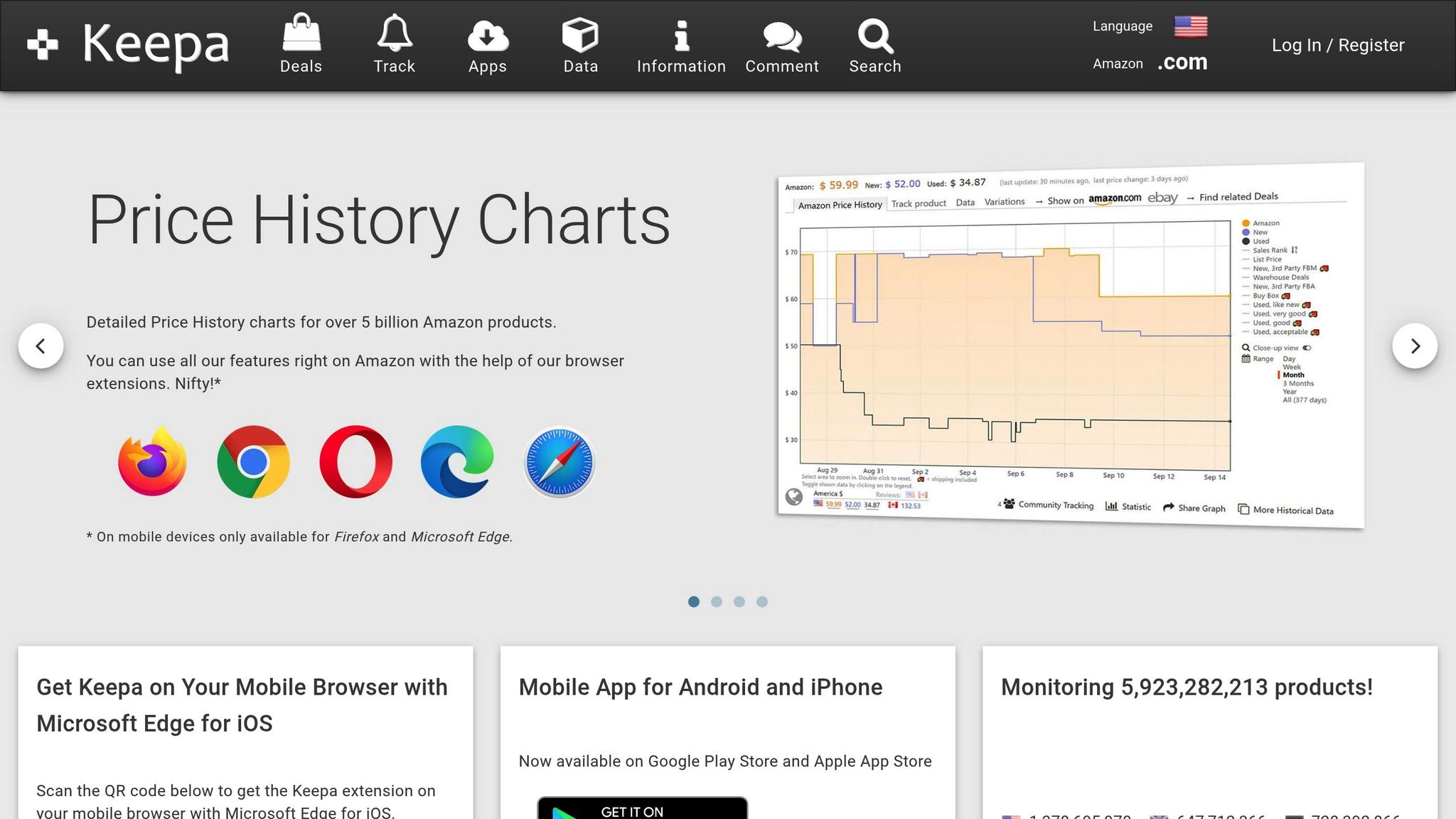
The Keepa API provides access to Amazon review data, but there’s not much publicly available information about its specific features. For instance, details on whether it supports real-time review collection or offers particular tools for review analysis remain unclear.
Information on pricing, scalability, and integration processes is also limited. To get accurate and up-to-date details about pricing plans, scaling capabilities, or how to integrate the API, you’ll need to reach out directly to Keepa’s team. Given the lack of public details, you might need to dig deeper to determine if the Keepa API aligns with your needs.
4. Jungle Scout API
Jungle Scout API doesn't share much public information about its real-time review collection, pricing, scalability, or integration options. If you're looking for detailed documentation, you'll need to reach out to Jungle Scout directly. They can provide insights into managing review volumes, cost structures, and available developer tools. However, this lack of readily available details might mean extra legwork for teams needing to assess technical specs before reaching out to sales. Up next, we’ll dive into a detailed comparison of features and pricing across these APIs.
5. Helium 10 API

Information about Helium 10 API's ability to gather real-time Amazon review data is scarce. Details like the number of reviews it can handle, how up-to-date the data is, API rate limits, pricing structure, and scalability remain unavailable to the public.
For more specifics, reach out directly to the Helium 10 team. They can provide documentation, integration guidance, and tailored pricing options. Meanwhile, consider exploring other APIs with similar features for comparison.
sbb-itb-d082ab0
6. SellerApp API
Information about the SellerApp API's capabilities for collecting Amazon reviews is scarce. Crucial aspects like real-time review access, data updates, API rate limits, integration processes, pricing details, scalability, and developer support are not publicly detailed. To get a full understanding of its features, pricing, and technical specifics, it's best to reach out directly to the SellerApp sales team.
7. DataHawk API
The DataHawk API doesn’t provide much public information about its features for gathering Amazon review data. Key aspects like real-time review capabilities, how often data is updated, pricing details, scalability options, and integration methods are not clearly outlined in publicly available documentation.
It’s also unclear whether the API uses REST or GraphQL architecture, what authentication methods it supports, or if there are SDKs available. Developers interested in using DataHawk will need to reach out to their team directly to get the full technical details, pricing information, and guidance on integration.
Like some other APIs in this comparison, the limited public documentation for DataHawk means businesses will face extra steps to understand its capabilities. This lack of upfront clarity makes it harder to evaluate technical requirements and compare it to other Amazon review API options.
Feature and Pricing Comparison
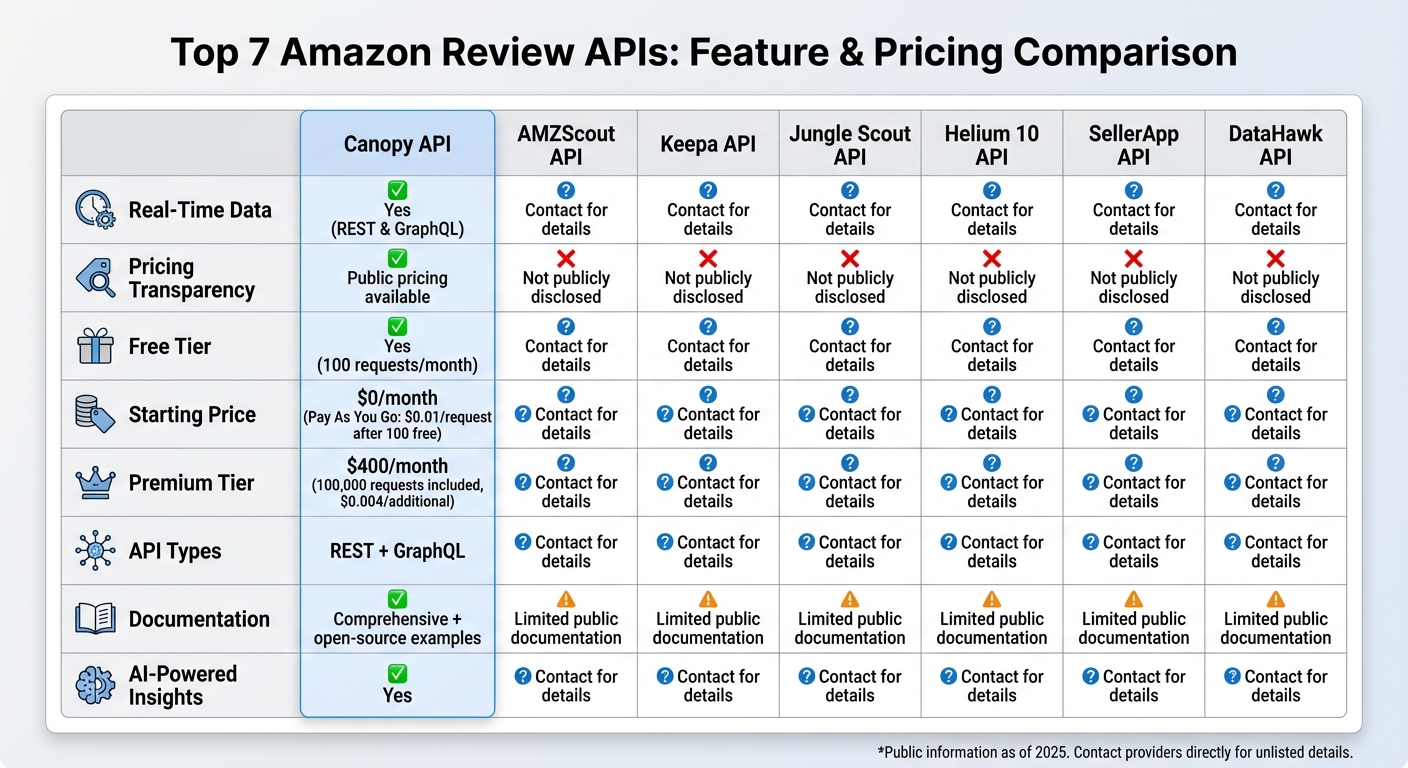
Amazon Review APIs Comparison 2025: Features and Pricing
Choosing the right API for extracting real-time Amazon review data means weighing the features and pricing of each option carefully. However, with limited public documentation for six of the competitors, this comparison focuses on the information that’s readily available.
Canopy API stands out for its transparent pricing and comprehensive documentation. It provides real-time data through both REST and GraphQL interfaces, making it a flexible option. This level of clarity and its scalable pricing structure set it apart from competitors, where public details are often sparse.
Here’s how Canopy API pricing works:
- The Hobby plan is completely free and includes 100 requests per month.
- The Pay As You Go plan starts at $0 per month, with volume discounts available for higher usage.
- The Premium plan begins at $400 per month and includes premium phone support for added convenience.
In contrast, pricing and feature details for AMZScout API, Keepa API, Jungle Scout API, Helium 10 API, SellerApp API, and DataHawk API are not publicly disclosed. To get specifics, you’ll need to contact each provider directly.
When evaluating your options, keep an eye on key factors like data freshness (real-time vs. cached), API flexibility, pricing transparency, scalability, and the quality of available documentation. These elements can significantly affect your development efforts, ongoing costs, and your ability to scale as your business grows.
Conclusion
When selecting an Amazon review API, it’s important to consider your business needs, budget, and long-term goals. Factors like data freshness, transparent pricing, and ease of integration play a crucial role in finding the right fit. These elements ensure the API not only addresses your current requirements but can also adapt as your business expands.
For those keeping a close eye on costs, Canopy API offers a free Hobby plan and flexible Pay As You Go options, providing room for growth without surprise expenses. On the higher end, premium plans - starting at roughly $400 per month - typically include larger request limits and access to dedicated support.
APIs that support both REST and GraphQL interfaces, combined with well-documented resources, can significantly speed up your implementation process. Access to reliable, real-time data is critical when dealing with Amazon reviews, and leveraging AI-powered insights can give you a competitive edge by improving product listings and enabling smarter, data-driven strategies.
Additionally, using an API eliminates the hassle of building and maintaining your own scraper, making the investment worthwhile.
FAQs
What are the main advantages of using an Amazon review API?
Using an Amazon review API offers businesses a range of benefits. With real-time access to customer reviews, you can uncover insights that help refine your products and maintain a strong brand reputation.
These APIs also simplify the process of collecting and analyzing large volumes of review data, eliminating the need for time-consuming manual work. By providing organized data, they make it easier to perform tasks like sentiment analysis and spotting trends, enabling faster and more informed decision-making.
What pricing options does Canopy API offer for businesses of different sizes?
Canopy API offers a pricing model designed to accommodate businesses of all sizes. The Hobby plan is completely free and provides 100 requests per month, making it ideal for small projects or those just starting out.
For businesses that are expanding, the Pay As You Go plan starts at $0 per month. It includes 100 free requests and charges $0.01 for each additional request, with discounts available for higher volumes.
For larger-scale operations, the Scale plan costs $400 per month and includes 100,000 requests. Additional requests are priced at $0.004 each, offering a more cost-efficient option for high usage. Businesses with unique requirements or significant demands can explore custom enterprise pricing, which includes tailored solutions and dedicated support to meet specific needs.
Why is it important to use real-time data when analyzing Amazon reviews?
Real-time data plays a crucial role in analyzing Amazon reviews. It enables you to act swiftly on customer feedback, spot new trends as they emerge, and tackle potential problems before they grow into bigger challenges. This kind of responsiveness not only enhances customer satisfaction but also keeps your product listings ahead in a competitive marketplace.
With current insights at your fingertips, you can make smarter choices about marketing campaigns, refine your products, and manage inventory more efficiently. The result? Increased sales and a stronger, more reliable brand image.