Real-Time Pricing APIs for Market Research
Use real-time pricing APIs to monitor competitor prices, forecast demand, and automate pricing decisions for faster, data-driven market research.

Businesses are using real-time pricing APIs to monitor Amazon's dynamic pricing, analyze trends, and optimize strategies. These tools automate competitor tracking, predict demand, and make pricing decisions faster than manual methods. APIs like Canopy provide instant access to data on over 350 million Amazon products, enabling companies to stay competitive and improve profitability.
Key Takeaways:
- Automated Price Tracking: APIs monitor Amazon's fluctuating prices and send alerts for critical changes.
- Trend Analysis: Historical and real-time data help forecast demand and identify market patterns.
- Scalability: Solutions like Canopy API handle high request volumes, making large-scale research cost-efficient.
- Actionable Insights: Access to Amazon sales data, stock levels, and review sentiment supports smarter pricing decisions.
Using APIs eliminates the need for spreadsheets and unreliable scrapers, allowing businesses to act quickly and efficiently in a fast-moving e-commerce environment.
Benefits of Real-Time Pricing APIs for Market Research
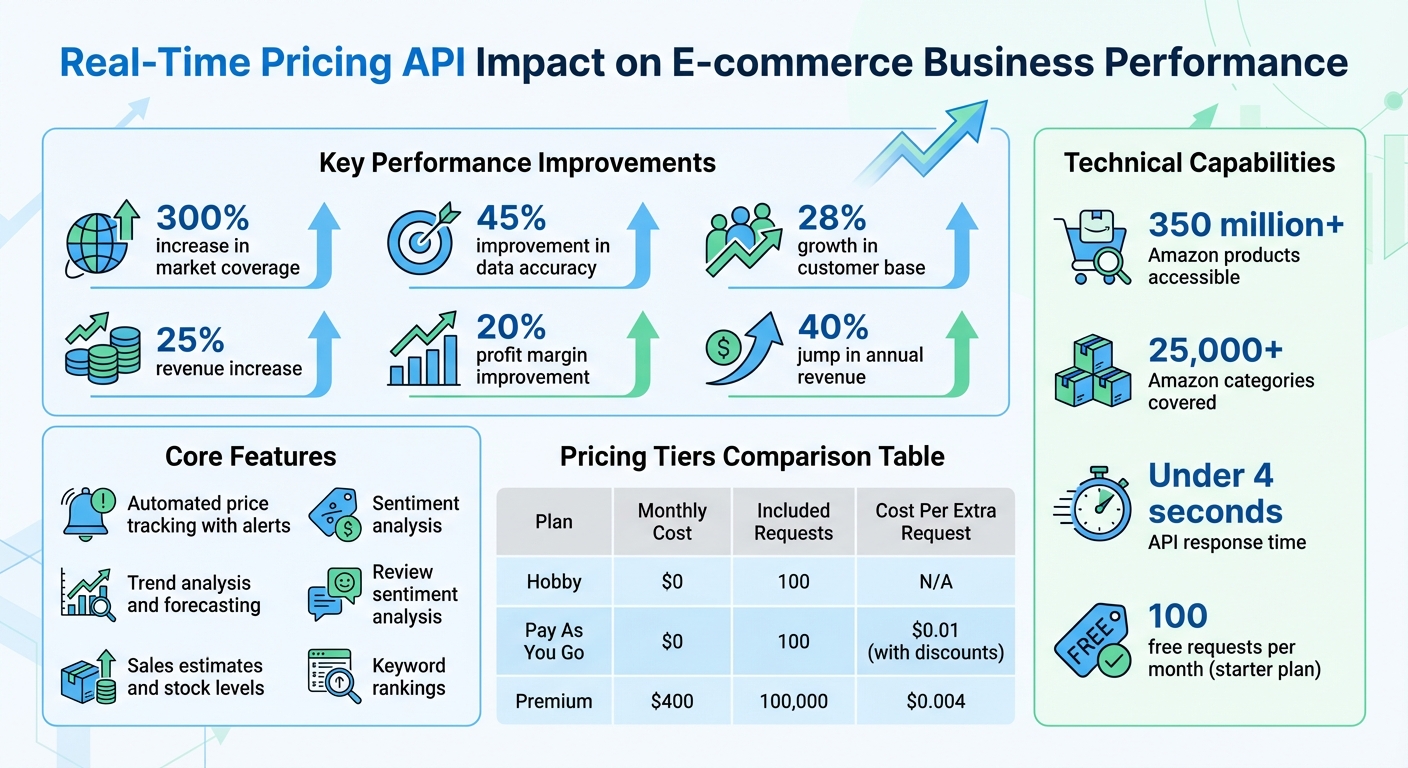
Real-Time Pricing API Benefits and ROI Statistics for E-commerce Businesses
Automated Competitor Analysis
Keeping up with Amazon's ever-changing prices is nearly impossible with manual tracking. Real-time pricing APIs solve this challenge by continuously gathering and organizing pricing data from e-commerce platforms, eliminating the need for error-prone spreadsheets or unreliable scrapers.
These APIs also provide automated alerts to notify businesses of critical changes, such as competitor price drops or inventory shifts. Alerts can be delivered through email, webhooks, or SMS, enabling quick responses. By integrating real-time data with internal cost structures, businesses can protect their profit margins with ease.
For example, the Canopy API's GraphQL endpoint (https://graphql.canopyapi.co/) lets researchers pull only the fields they need - like price and availability - streamlining data collection. Covering over 25,000 Amazon categories, it delivers detailed market intelligence, including sales estimates, stock levels, review sentiment, and keyword rankings. This comprehensive data helps businesses gain a deeper understanding of their competition and supports proactive trend analysis.
Trend Identification and Forecasting
Real-time pricing data offers a clear view of seasonal trends and sudden demand shifts as they occur. By analyzing historical price patterns, businesses can predict competitor strategies and plan promotions effectively.
Accurate forecasting relies on correlating multiple metrics. For instance, rising prices combined with strong sales estimates suggest growing demand, whereas steady sales with falling prices could indicate market saturation. One SaaS platform using a real-time pricing API reported a 300% boost in market coverage, a 45% uptick in data accuracy, and a 28% growth in its customer base. Monitoring entire product categories, rather than individual items, helps businesses identify broader market trends. Adjusting data polling frequency based on product volatility - checking fast-moving items more often and stable products less frequently - ensures cost-effective yet timely insights. With API response times under 4 seconds, businesses can react quickly to time-sensitive promotions and fast-changing market conditions.
This kind of trend analysis not only sharpens forecasting but also ensures efficient use of resources.
Scalability and Cost Efficiency
Canopy API's REST (https://rest.canopyapi.co/) and GraphQL endpoints are designed to handle high request volumes without requiring businesses to invest in their own infrastructure. With access to over 350 million Amazon products, this platform makes large-scale market research accessible, as per-request costs decrease with higher usage.
Features like caching, request batching, and data compression further reduce unnecessary API calls, helping businesses save on operational costs. The pay-per-use pricing model is particularly advantageous during seasonal fluctuations, as it ensures businesses only pay for the data they need. This eliminates the overhead of scaling servers typically associated with traditional scraping methods while benefiting from economies of scale.
| Plan | Monthly Base Cost | Included Requests | Extra Request Cost |
|---|---|---|---|
| Hobby | $0 | 100 | N/A |
| Pay As You Go | $0 | 100 | $0.01 (discounts apply) |
| Premium | $400 | 100,000 | $0.004 |
The platform's user-friendly documentation and straightforward integration process allow businesses to focus on their core operations instead of worrying about maintaining data infrastructure. By combining flexible pricing with scalable solutions, Canopy API empowers market researchers to grow their capabilities without inflating overhead costs.
How to Use Canopy API for Real-Time Pricing Data
Setting Up and Authenticating Canopy API
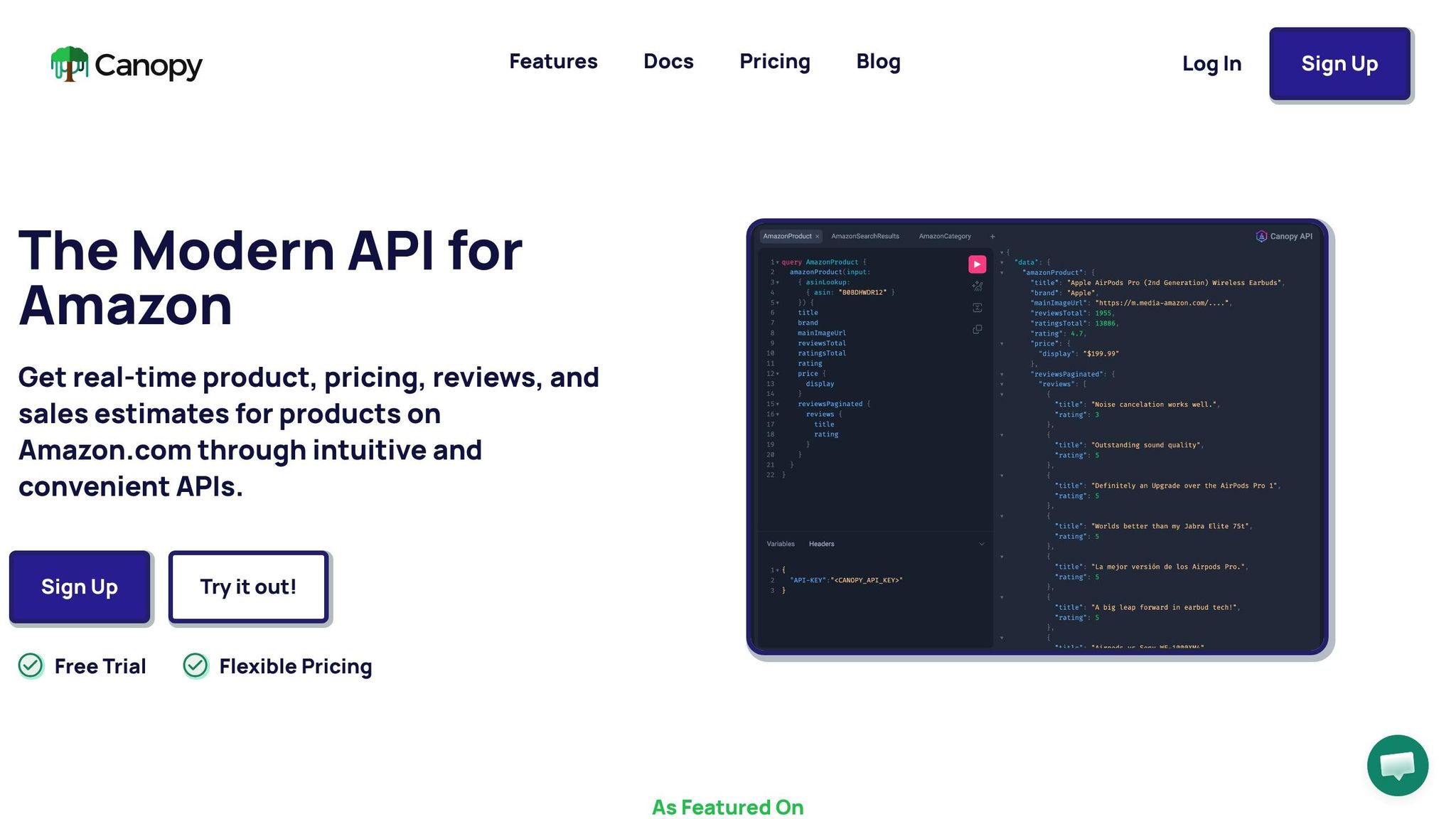
To get started with the Canopy API, the first step is to register at canopyapi.co and create an account. After signing up, you'll receive a unique API key, which will be displayed on your product dashboard. Make sure to store this key securely as an environment variable - it's important to avoid hardcoding it into your source code to maintain security.
When making API requests, include your API key in the API-KEY header. This applies whether you're using the REST endpoint (https://rest.canopyapi.co/) or the GraphQL endpoint (https://graphql.canopyapi.co/). Adding the key ensures your requests are authenticated and processed correctly.
Once authentication is set up, you can start retrieving pricing data through either the REST or GraphQL endpoints.
Fetching Product Pricing Data
The Canopy API provides two options for accessing pricing data: the REST API and the GraphQL API. Each has its strengths, depending on your needs:
- REST API: Ideal for simple GET requests where you need specific product details quickly.
- GraphQL API: Perfect for more complex queries, allowing you to request only the fields you need. This reduces bandwidth usage and improves overall performance.
Here’s an example of how to fetch pricing data using the REST API with JavaScript:
const asin = 'B0B3JBVDYP';
const API_KEY = '<YOUR_API_KEY>';

const response = await fetch(`https://rest.canopyapi.co/api/amazon/product?asin=${asin}&domain=US`, {
  method: 'GET',
  headers: {
    'API-KEY': API_KEY,
    'Content-Type': 'application/json'
  }
});

if (response.ok) {
  const data = await response.json();
  console.log(data.price.display); // Example output: "$12.99"
}
For scenarios where you need more control, such as querying multiple data points, the GraphQL API is a better fit. Here's an example:
const query = `
  query amazonProduct($asin: String!) {
    amazonProduct(input: { asinLookup: { asin: $asin, domain: US } }) {
      title
      price {
        display
        value
      }
    }
  }`;

const API_KEY = '<YOUR_API_KEY>';

fetch('https://graphql.canopyapi.co/', {
  method: 'POST',
  headers: {
    'Content-Type': 'application/json',
    'Authorization': `Bearer ${API_KEY}`
  },
  body: JSON.stringify({
    query,
    variables: { asin: "B0D1XD1ZV3" }
  })
})
.then(res => res.json())
.then(result => console.log(result.data.amazonProduct.price.display));
Error Handling and Best Practices
To maintain reliability and ensure accurate data, follow these best practices when using the Canopy API:
-
Error Handling: Always check the response status codes. Common errors include:
- 401 (Unauthorized): This happens when the API key is missing or invalid.
- 404 (Not Found): Occurs when the provided ASIN doesn't exist (you can verify codes with an Amazon ASIN Validator).
- 500 (Server Error): Indicates temporary issues with the service.
- 429 (Too Many Requests): Signals you've hit the rate limit. Use exponential backoff (e.g., wait 1, 2, then 4 seconds) to retry.
- Batch Requests: For large-scale operations, batch your API calls and use queuing to spread requests over time. This prevents overwhelming the API and hitting rate limits.
- Data Validation: Ensure price values are numeric and fall within expected ranges before storing them. Verify timestamps to confirm the data is up-to-date.
- Caching: Reduce redundant API calls by caching recent pricing data locally. This is particularly useful for products with stable prices.
- Polling Frequency: Adjust how often you check for updates based on the product's market activity. Competitive products may need updates every few minutes, while less volatile items can be checked hourly. This approach balances the need for timely insights with cost management.
sbb-itb-d082ab0
Practical Use Cases for Real-Time Pricing APIs
Real-time pricing data does more than just help businesses stay competitive - it provides critical insights for demand analysis and market trends. Let’s explore how companies are using APIs to turn pricing data into actionable strategies.
Competitor Price Tracking
Manually tracking competitors' prices is not only tedious but also prone to mistakes. Real-time pricing APIs simplify this process by automating the monitoring of thousands of products at once. For example, you can set up alerts that notify you when a competitor reduces their price by more than 5% or drops below a specific threshold - such as $49.99 when your price is $54.99.
With automation, businesses can react within minutes rather than days, adjusting prices to stay competitive while maintaining profitability.
Here’s a quick JavaScript snippet using Canopy API to track a competitor’s price and trigger an alert:
const competitorAsin = 'B08N5WRWNW';
const yourPrice = 54.99;
const alertThreshold = 0.05; // 5% price drop

const response = await fetch(`https://rest.canopyapi.co/api/amazon/product?asin=${competitorAsin}&domain=US`, {
  method: 'GET',
  headers: {
    'API-KEY': process.env.CANOPY_API_KEY,
    'Content-Type': 'application/json'
  }
});

const data = await response.json();
const competitorPrice = data.price.value;

if (competitorPrice < yourPrice * (1 - alertThreshold)) {
  console.log(`Alert: Competitor dropped price to ${competitorPrice}`);
  // Trigger repricing logic or notification
}
Beyond just prices, you can track factors like Prime eligibility, stock levels, and product condition. If a competitor’s inventory is running low, it might be a good time to slightly increase your prices or ramp up marketing to capture their lost sales. These insights also contribute to better demand forecasting and pricing strategies.
Demand Forecasting and Pricing Optimization
When paired with sales data, pricing information becomes a powerful tool for predicting customer behavior. By analyzing how price changes impact sales volume, businesses can estimate demand elasticity and adjust accordingly. For instance, if historical data shows that a 10% price cut typically results in a 15% sales boost, you can use this knowledge to plan promotions more effectively.
This approach is especially useful during high-demand periods like Black Friday. Suppose you’re tracking a smart speaker originally priced at $349. If your API data reveals the average price has dropped to $299 and sales have doubled, you might forecast a 20% demand increase and set your price at $289 to balance volume and profit.
The trick is to combine multiple data points - such as price, sales rank, and inventory levels - to create predictive models that guide both pricing and inventory decisions.
Trend Analysis Across Product Categories
Tracking individual products is crucial, but analyzing data across entire categories uncovers broader market trends. For example, querying over 100 products weekly in categories like electronics, apparel, or home goods can reveal seasonal patterns. You might notice consistent price drops in fashion items at the end of each quarter or rising prices for home goods before major holidays.
Aggregated data also helps differentiate between stable markets - characterized by high ratings, many reviews, and steady prices - and emerging opportunities, where fewer reviews and fluctuating prices indicate room for growth.
With Canopy API’s extensive coverage of over 25,000 Amazon categories, it’s easy to perform category-level analysis. Instead of focusing on individual products, you can track entire segments to identify shifts. For instance, if Prime-eligible products in a category consistently command higher prices, it could highlight the value of enhanced fulfillment options. Storing this historical data allows you to predict competitor moves during peak shopping events like Prime Day or the holiday season.
Conclusion
Real-time pricing APIs have revolutionized how businesses approach market research. Instead of relying on outdated spreadsheets or waiting for weekly updates, companies can now access structured data within seconds. This allows for quick price adjustments, accurate demand forecasting, and precise competitor monitoring - all of which are crucial in today’s fast-moving e-commerce landscape, where prices can fluctuate multiple times a day.
Canopy API stands out by offering scalable, real-time Amazon data through its REST (https://rest.canopyapi.co/) and GraphQL (https://graphql.canopyapi.co/) endpoints. Whether you’re tracking a few competitors or analyzing entire product categories, the platform handles it effortlessly. It eliminates the need for custom-built scrapers and adds AI-powered insights to turn raw data into actionable strategies.
The results speak for themselves. Businesses leveraging these tools have reported revenue increases of up to 25%, expanded market coverage by 300%, and improved profit margins by 20%. One pricing SaaS platform saw its customer base grow by 28% after implementing automated tracking, while another experienced a 40% jump in annual revenue.
From optimizing Black Friday deals to identifying emerging fashion trends or keeping tabs on competitors, real-time data enables businesses to act swiftly and decisively. Canopy API offers flexible pricing options, starting with 100 free requests per month, making advanced market research accessible for businesses of all sizes.
The shift from manual processes to automated intelligence isn’t just about efficiency - it’s about gaining a lasting edge. Automating competitor analysis, refining demand forecasts, and optimizing pricing strategies in real time strengthens market positioning. Every well-timed price adjustment and trend spotted early reinforces the competitive advantage. That’s the transformative power of real-time pricing APIs.
FAQs
How can real-time pricing APIs improve market research?
Real-time pricing APIs transform market research by providing current and accurate market data, enabling businesses to respond quickly and make smarter decisions. These tools keep a constant watch on competitor pricing, stock availability, and sales trends, giving companies the agility to adjust strategies on the fly.
For instance, businesses can set up automated alerts for price drops, inventory changes, or unexpected sales surges, cutting down on manual monitoring. This not only reduces effort but also ensures they remain competitive in dynamic markets. By simplifying data collection and delivering actionable insights, these APIs help businesses save time, allocate resources more effectively, and identify fresh opportunities for growth.
What are the main benefits of using Canopy API for real-time pricing data?
The Canopy API equips businesses with real-time Amazon pricing data, offering a competitive edge in fast-paced markets. With instant access to details like prices, stock levels, and sales performance, businesses can fine-tune pricing strategies, keep an eye on competitors, and manage inventory with greater precision.
The API is versatile, supporting both GraphQL and REST endpoints to fit diverse technical requirements. Its AI-driven insights take things further by enabling trend analysis and demand forecasting, helping businesses make smarter, data-backed decisions. Whether you're a small business or a growing enterprise, the system is built to scale alongside your needs.
By simplifying access to detailed pricing data, the Canopy API cuts down on engineering overhead and empowers businesses to respond swiftly to market shifts.
How can businesses use real-time pricing data to stay competitive?
Businesses can take advantage of real-time pricing data to stay competitive by adopting dynamic pricing strategies and making quicker, well-informed decisions. Tools like Canopy API provide up-to-the-minute pricing insights, enabling companies to track competitor prices, identify trends, and fine-tune their own pricing strategies. This proactive approach helps businesses avoid missed opportunities caused by outdated pricing and allows them to adapt swiftly to market shifts.
Access to real-time data also supports demand forecasting and inventory management. By monitoring sales projections, stock levels, and search rankings, businesses can minimize the risk of stockouts, streamline inventory, and more accurately predict what customers will want. On top of that, automated price alerts and competitor tracking empower companies to respond immediately to price changes or evolving consumer behavior. This ensures they maintain a competitive edge and maximize profitability.